After writing a sequence of horrifying nightmare poems, I decided to attempt a life-affirming, positive poem.
I wrote it in two parts, out of an intended three: I was aiming for a triptych. But after Pt2 I felt my heart wasn’t in it. I abandoned that poem and didn’t write another poem for about 30 years. When I re-read this one I thought it was awful, Hallmark greeting card stuff. I chucked Pt2 altogether. This is Pt1.
I.
A woman pulled a rib from out of my side and my heart stepped out. she looked just like me: a small grey-eyed, soft-fleshed, female me.
My daughter he said. I am not ashamed to recognise love. I see no shame in relatedness. Her eyes are mine, and she is my heart.
He walks her up the road. He holds her hand. she rides on his back and she laughs.
My daughter he says, and her arms curl around his neck as years ago he sucked the breast of a woman
he loves
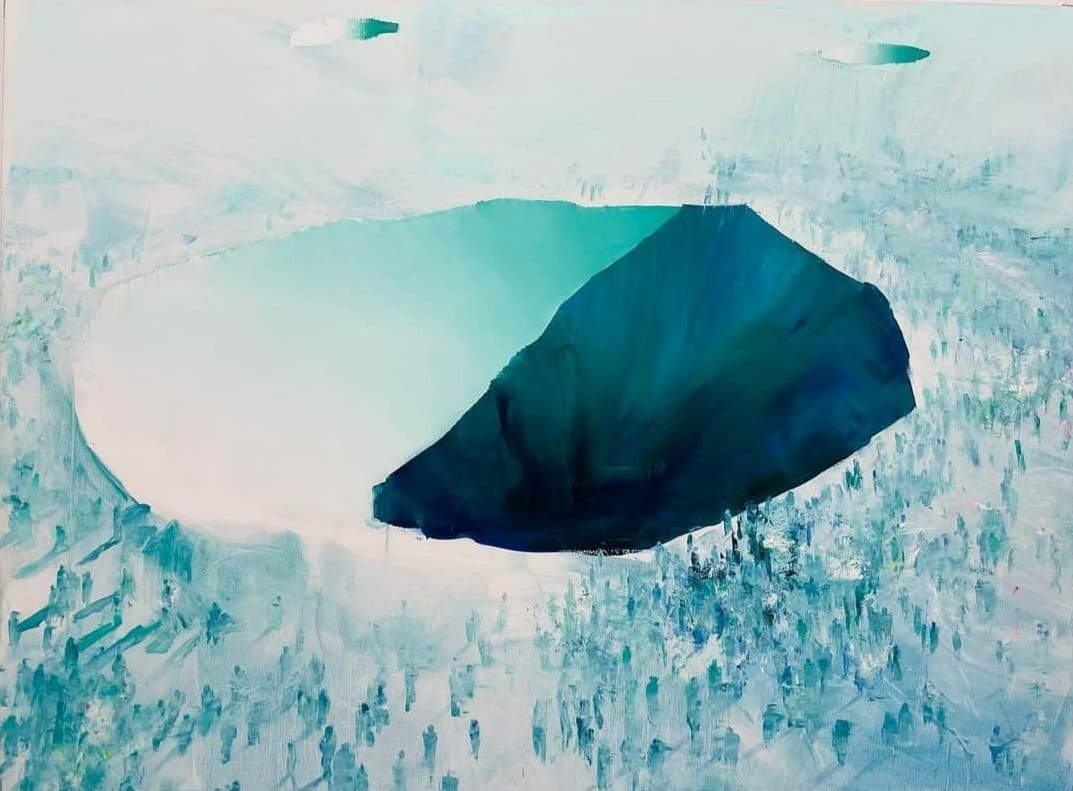
Artwork by Jenny Pollak @jenny_pollak_artist from ‘Bloodlines’ series, 2010
limbs contorted, tearing thick air: white fleshy
boomerangs broken
arms, snapped ribs: eyes fear-forced open, bruised and
swollen closed, the smashed
nose and plates, bent knives, kicked in
door
permanent
images, fixed like that clock – one hand
wrenched off, stoved in and reckless, lying
on its side on the living
room floor – no progress, not ever, silenced and
strange; or the door-frame, splintered
as readily as bone – the violated
flywire, the hammer-bashed
lock: glass stabbed curtains and blood
in the bathroom – the bride in the photo
(no sound) lies senseless, scrunched up
and torn
face downwards
Unbalanced, tall buildings loom
above us: screening out the sky, too close
together – like cramped teeth they jut
in shades of bone decay. I look quickly
at her
she looks down, and frowns
Uneven, the roadface staggers before
us. Cobblestones: smooth swellings
cemented together, colourless, so cold –
like trampling
thousands of hardened dead
breasts. Now she turns on me
her death’s head, survivor’s stare
black
streets drop away, breath
catches, while rain
– not quite falling –
hangs in dark clumps of
night and possums sit
in the middle of a fence
nightfall
wide-eyed, they observe – not caring
neither way
we mean nothing, this is nothing
not to them, not us
come away
from here, take care
in this dark, bright-eyed
with cars – we are blinded
by cars –
in public, all observed
two possums stare
balanced on a fence
you and I, eye to eye
you and I, watching on
small blundering familiars
neither comprehend nor care
my hand reaches out
to your shoulder, instinctive – I touch
your neck:
warm and unresponsive – you’re scared
we two, clinging lightly
lean on each other
look up, look and see large
luminous eyes
in a damp-cheeked night
walking onwards, then at once pulled up pulled back – as if by an image reflected in a window, a face once-known your own aged features – sharp-edged, so white – a bloodless light hand reaches out touch finger touch phantom a skeleton bridge half-flesh, half-hope: the ghost behind your eyes steps out, stands beside you but it can’t be you at all
not this time. In half dark (half-light into night), it’s someone you remember: someone else.
Your stare mirrors his; the ghost you’ve become sees itself living, behind his eyes reflected; in the present, it relives a scene from the past. It stares through a window and sees you both there – profiles overlapping, fingers touch flesh… the man (who is him) looks up stops stares out the window, straight at the phantom, half-sees through shadow: he says I once knew her The girl with him smiles (she is you, and she smiles) Go on, go and tell her ‘good to see her again. Go out there and talk but He looks away and whispers She won’t talk to me now
now on this street you stop, you stare you can see yourself touching (white lip touches shoulder), phantom lips plead promise me don’t ever walk past me, don’t let me walk past No matter what happens, whoever we become, I will always stop:
1. Lady in orange we like you No real reason Just your treble clef curves Those playground heels The way your hair foofs Like a TV commercial come To life The bow’n’arrow smile The narrowed eyes That bag slung over your shoulder shouts money
2. You are my perfect woman. Come out with me. Here is my phone number. I have a job.
Photo from UN Women FB
Death Sports
There are no excuses for us. We are still the savage species thrilling to dog fights bear baiting cock fighting. Death sports. The fall of the fortunate our enemies hacked to death. Not even our enemies The cats in the sack ignite
We must know the law is an ass. We only believe in the mob.
I find myself unable to work with WordPress Block editing. Apologies to the poets whose poems are not set out as they should be here.
Lee Herrick
Flight
The in-flight magazine crossword partially done, a corner begun here, scratched out answers there, one set of answers in pencil, another in the green. The woman with the green ball point knew the all-time hit king is Rose and the Siem Reap treasure is Angkor Wat. The woman, perhaps en route to hold her dying mother’s hand in Seattle, forgot about death for ten minutes while remembering her husband’s Cincinnati Reds hat while gardening after the diagnosis. Her handwriting was so clean. Maybe she was a surgeon. Maybe a painter. No. What painter wouldn’t know 17 down, Diego’s love, five letters? In a rush, her dying mother’s voice came back to her, or maybe she was Chinese and her mother’s imagined voice said, wo ai ni. At 30,000 feet, you focus on 33 across, Asian American classic, The Woman ________, when a stranger in the window seat sees the clue, watches me write in W, and she says Warrior, and for a moment you forget it is your favorite memoir, and she reminds you of lilies or roses, Van Gogh or stems with thorns, art galleries in romantic cities where she is headed but you should not go. The flight attendant grazes my shoulder. The crossword squares, the letters, the chairs and aisles seem so tight in flight, but there is nothing here but room, really. Maybe the next passenger will know what I do not: 64 down, five letters, Purpose. And why do we remember what we do? We know the buzz of Dickinson’s fly and the number of years in Marquez’s solitude, but some things we will never know, as it should be: why the body sometimes rumbles like a plane hurtling over southern Oregon, how exactly we fall in love, or if Frida and Maxine Hong Kingston would have loved the same kind of tea.
Originally published in Daily Gramma, October 2016.
The Birds Outside My Window Sing During a Pandemic
What we need has always been inside of us. For some—a few poets or farmers, perhaps— it’s always near the surface. Others, it’s buried. It was in our original design, though—pre-machine, pre-border, pre-pandemic. I imagine it like the light one might feel through the body before dying, a warm calm, a slow breath, a sweet rush. There is, by every measure, reason for fear, concern, a concert in the balcony of anxiety made of what has also always been inside of us: a kind of knowing that everything could break. But it hasn’t quite yet and probably won’t. What I mean to say is, I had a daydream and got lost inside of it. There were dozens of birds for some reason, who sounded like they were singing in different accents: shelter in place, shelter in place. You’re made of stars and grace. Stars and grace. Stars—and grace.
Originally published in MiGoZine, March 2020.
∞
Burlee Vang
To Live in the Zombie Apocalypse
The moon will shine for God knows how long. As if it still matters. As if someone
is trying to recall a dream. Believe the brain is a cage of light & rage. When it shuts off,
something else switches on. There’s no better reason than now to lock the doors, the windows.
Turn off the sprinklers & porch light. Save the books for fire. In darkness,
we learn to read what moves along the horizon, across the periphery of a gun scope—
the flicker of shadows, the rustling of trash in the body of cities long emptied.
Not a soul lives in this house & this house & this
house. Go on, stiffen the heart, quicken the blood. To live
in a world of flesh & teeth, you must learn to kill
your little voice
                              Over the wires came leaping
and i felt suddenly
dizzy
          With the jostling and shouting of merry flowers
wee skipping high-heeled flames
courtesied before my eyes
                                                or twinkling over to my side
Looked up
with impertinently exquisite faces
floating hands were laid upon me
I was whirled and tossed into delicious dancing
up
Up
with the pale important
                                                stars and the Humorous
                                                                                                moon
dear girl
How i was crazy how i cried when i heard
                                                                              over time
and tide and death
leaping
Sweetly
               your voice
Jane Hirshfield
Like Others
In the end, I was like others. A person.
Sometimes embarrassed, sometimes afraid.
When “Fire!” was shouted, some ran toward it, some away—
I neck-deep among them.
—2017
Lawrence Ferlinghetti
Recipe For Happiness Khaborovsk Or Anyplace
“Poetry is a naked woman, a naked man, and the distance between them.”
One grand boulevard with trees with one grand cafe in sun with strong black coffee in very small cups.
One not necessarily very beautiful man or woman who loves you.
One fine day.
Alexandra Teague
Adjectives of Order
That summer, she had a student who was obsessed
with the order of adjectives. A soldier in the South
Vietnamese army, he had been taken prisoner when

Saigon fell. He wanted to know why the order
could not be altered. The sweltering city streets shook
with rockets and helicopters. The city sweltering

streets. On the dusty brown field of the chalkboard,
she wrote: The mother took warm homemade bread
from the oven. City is essential to streets as homemade

is essential to bread . He copied this down, but
he wanted to know if his brothers were lost  before
older, if he worked security at a twenty-story modern

downtown bank or downtown twenty-story modern.
When he first arrived, he did not know enough English
to order a sandwich. He asked her to explain each part

of Lovely big rectangular old red English Catholic
leather Bible. Evaluation before size. Age before color.
Nationality before religion. Time before length. Adding

and, one could determine if two adjectives were equal.
After Saigon fell, he had survived nine long years
of torture. Nine and long. He knew no other way to say this.
Man in a chicken suit, you’re the only one today not selling beauty: 5th Avenue star-struck with Christmas, three-story diamonds and flocks of ballerinas pirouetting clockworking gears as if the Industrial Revolution were a life-sized music box of desires and we’ve just kept on winding. If. And Wish Upon. And shopping bag. And you with your wind-ruffled feathers and flyers, pleading for our primitive hungers. That inelegant grease spot and crunch to remind us. The mannequins don’t even have bones. I’ll never have a purse nice enough to hold a wallet worth the money to buy the purse at Barney’s. And what does it matter? There are drumsticks. I’m a vegetarian. You are no masked creature worth hugging for a picture. No Minnie. No marble nymph of Beauty in pigeon net outside the library: old yet ever new eternal voice and inward word. As if we hear it clear in the gizzard: Beauty is God and love made real. You will be this beautiful if. You are the rock in the crowd-raked garden of traffic, just past the corner of jaguar-made-of-dazzle and flapper reading Shakespeare bound in bardic sparkles. Your yellow, a scant flag to claim us: ordinary strange as holy chickens in a gilded cage in Spain. Their ancestors, heralds of a miracle. A huge mechanical owl recites Madonna in a window Baz Luhrmann designed since February. It takes all year for a miracle with this many moving parts. All of us in a rush to wait for the catastrophe of personality to seem beautiful again. As if this is the best we can hope for: seeming to ourselves—like panhandlers dressed as Buddhist monks the real monks are protesting. Asked for her secret, the model for Beauty said, The dimples on my back have been more valuable to me than war bonds. Asked for proof, one orange-robed woman said, I can’t tell you where, but I do have a temple. Beaked promise of later lunch, catastrophe of unbeautiful feather, how can we eat the real you that you are not? Which came first? The shell to hatch desire, or desire? Which skin holds my glittering temple?
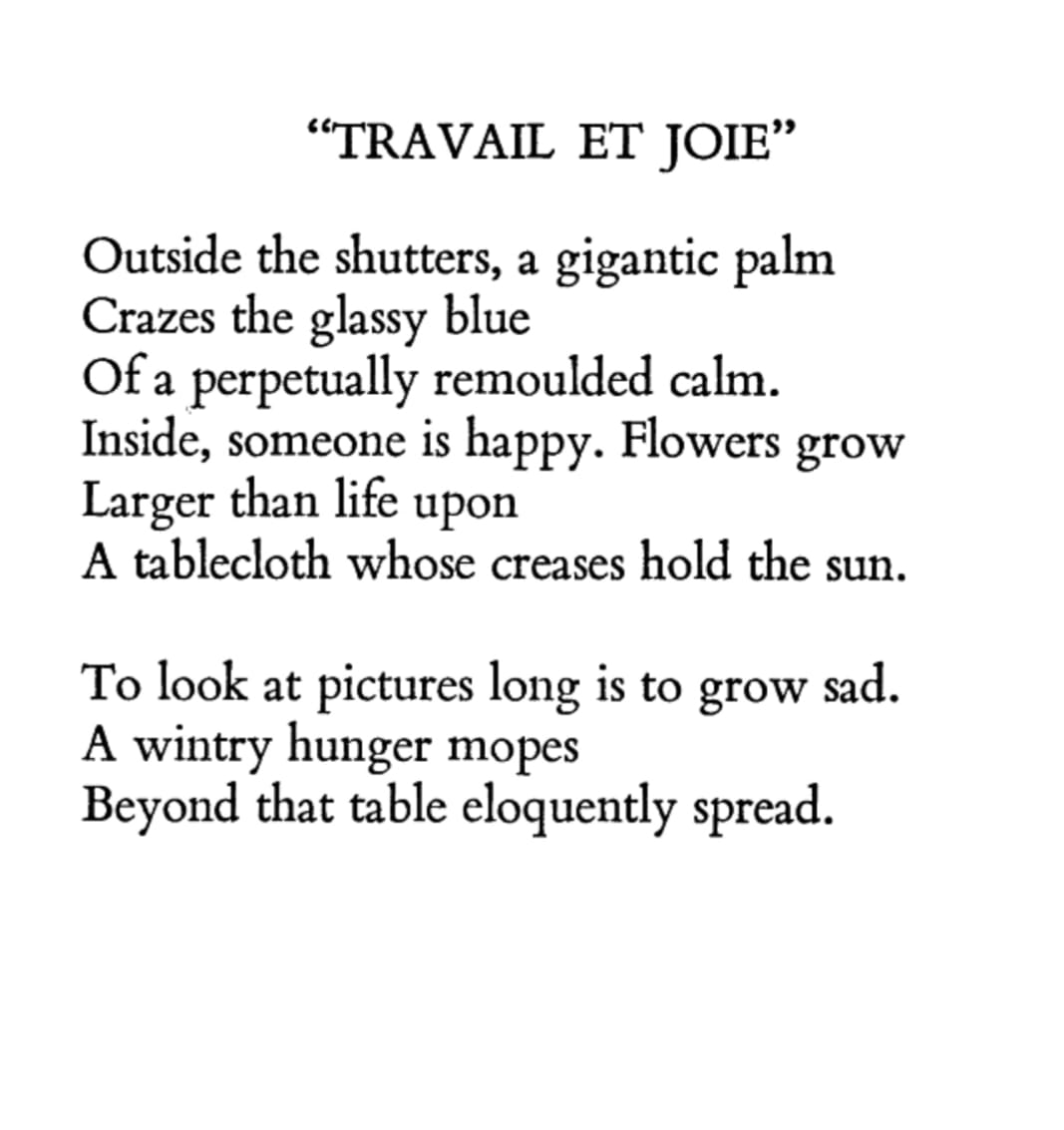
Of course you know her. She is one and many, A multitude flashing on, then off, Watching out from the tidy blank of her face. She is silent, speaking With just her mind. She is flesh, a form, but also flat, a mute screen. What she offers you, by no means Should you accept. She belongs to no-one, sitting like a ghost beyond her own reach. And yet, she’s there—I mean me— Behind glass, as if the world has been cleaved, Though something whole remains, Roving, free, a voice with poise and pitch. She’s there—me—snug in the glass, The little mirror on the bedside Doing its one trick A hundred times a day. You didn’t come to live with me.
2. Turkish Bath
The room is choked with nudes. Once, a man tried to muscle in by mistake Crying, “Turkish bath!” He had no idea My door is always locked in this heat, No idea that I am the sole guest and client, The chief consort, that I cast my gaze Of pity and absolute pride across The length of my limbs—lithe, pristine— The bells of my breasts singing, The high bright note of my ass, My shoulders a warm chord, The chorus of muscle that rings Ecstatic. I am my own model. I create, am created, my bed Is heaped with photo albums, Socks and slips scatted on a table. A spray of winter jasmine wilts In its glass vase, dim yellow, like Despondent gold. Blossoms carpet The floor, which is a patchwork Of pillows. Pick a corner, sleep in peace. You didn’t come to live with me.
3. Curtain Habit
The curtain seals out the day. Better that way to let my mind See what it sees (every evil under the sun), Or to kneel before the heart, quiet king, Feeling brave and consummately free. Better that way to let all that I want And all I believe swarm me like bees, Or ghosts, or a cloud of smoke someone Blows, beckoning. I come. I cry out In release. I give birth To a battery of clever babies—triplets, Quintuplets, so many all at once. The curtain seals in my joy. The curtain holds the razor out of reach, Puts the pills on a shelf out of sight. The curtain snuffs shut and I bask in the bounty Of being alive. The music begins. Love pools in every corner. You didn’t come to live with me.
4. Self-Portrait
The camera snaps. Spits me out starkly ugly. So I set out to paint the self within myself. It takes twelve tubes, blended to a living tint, Before I believe me. I name the mixture Color P. The hair—curious, unlikely—is my favorite, The same fluff of bangs tickling my niece’s face. And my eyebrows are wide as hills. They swallow everything. They are a feat. They do not impress me as likely to age. They are brimming with wisdom. Neither slavish nor stern. Not magnificent, but not the kind made to crumple in shame. Not prudish. Unwilling to arch and beckon like a whore’s. They skitter away from certainties like alive or dead. My self-portrait hangs on the narrow wall, And I kneel down to it every day.
You didn’t come to live with me.
5. Impromptu Party
The little table is draped with a festive cloth, and Light blurs out from a single lamp, making us fuzzy.
A sip of red wine, and I rise to my feet. We are Dancing, my guests and I, like kids in a ballroom.
We don’t smile or even speak. We’ve had a lot to drink.
To a single woman, time is like a scrap of meat: Nothing you can afford to give away. I want
To hold it in my lap, Time, that sneak, that thief already Scheming to break free. Please—I beg
Upon the magnificent extravagance of my beloved stilettos, I want the world back. I’ve been alive—could it be?—
Near a century. My face has closed up shop. My feet are a desolate country.
For a single woman, youth is a feast that lasts Only until it is gone.
You didn’t come to live with me.
6. Invitation
When it arrived, I was interrupted by relief, Sitting in my rattan chair, feeling the wind ease in Through the hole in my life.
I only said yes because of his dissertation. Friends, Nothing more. We talked—he talked—about modernism, Black humor. But always at a distance from reality.
Why didn’t he ask me anything? Tender and petulant, he struck me as cute. But at heart, only a very well-behaved boy.
He offers his arm. Elegant, decent, gallant. But how can I prove myself a woman If he is a child? What can come of that union?
Can any of us save ourselves? Save another?
You didn’t come to live with me.
7. Sunday Alone
I don’t picnic on Sundays. Parks are a sad song; I steer clear. But I dug out all my sheet music, I lolled about in the Turkish Bath Singing from breakfast to tea. With my hair, I sang Do And my eyes, Re And my ear sounded Mi And my nose went after Fa My face tilted back and out rose So My mouth breathed La My whole body birthed Ti Like my cousin said, famously— Music is the soul sighing. Music pushes back against pain. Solitude is great (but I don’t want Greatness). My eyes slump Against the walls. My hair Hurls itself at the ceiling like a colony Of bats. You didn’t come to live with me.
8. Dialectic
I read materialist philosophy— Material ispeerless. But I’m creationless. I don’t even procreate. What use does the world have for me Here beside my reams of cock-eyed drafts That nick away at the mountain of Art and philosophy? Firstly, Existentialism. Secondly, Dadaism. Thirdly, Positivism. Lastly, Surrealism. Mostly, I think people live For the sake of living. Is living a feat? What will last? My chief function is obsolescence. Still, I send out my stubborn breath In every direction. I am determined To commit myself to a marriage Of connivance. You didn’t come to live with me.
9. Downpour
Rain hacks at the earth like an insatiable man. Disquiet, like passion, subsides instantly. Six distinct desires mate, are later married. At the moment, I want everything and nothing. The rainstorm barricaded all the roads. Sandbags. Isn’t there something gladdening about a dead-end? I canceled my plans, my trysts, my escapes. For a moment—I almost blinked and missed it—the storm Stopped the clock that chases me. The clock of the heart, maybe. It was an ecstasy so profound… “Ah, linger on, thou art so fair!” I’d rather admit despair. And die. You didn’t come to live with me.
10. Dream of Symbolism
I occupy the walls that surround me. When did I become so rectilinear? I had a rectilinear dream: The rectilinear sky in Leo: The head, for a while, shone brightest. Next the tail. After a while It became a wild horse Galloping into the distances of the universe, Lasso dragging behind, tethered to nothing. There are no roads in the black night that contains us. Every step is a step into absence. I don’t remember the last time I saw A free soul. If she still exists, fire-eyed gypsy, She’ll die young. You didn’t come to live with me.
11. Birthday Candles
They are like heaps of stars. My flat roof is like a private galaxy That stretches on stubbornly forever.
The universe created us by chance, Our birth, simple happenstance. Should life be guarded or gambled? Lodged in a vault or flung to the wind?
God announces: Happy Birthday. Everyone raises a glass and giggles audibly. Death gets clearer in the distance. Closer by a year.
Because all are afraid, none is afraid. It’s pity how fast youth sputters and burns, Its flame like the season’s last peony. A bright misery.
You didn’t come to live with me.
12. Cigarette
I lift it to my lips, supremely slim, Igniting my desire to be a woman. I appreciate the grace of the gesture, Cosmopolitan, a shorthand for beauty, The winding haze off the tip like the chaos of sex. Loneliness can be sweet. I re-read the paper. The ban on smoking underway Has gotten a bonfire of support. A heated topic, Though I find it inflammatory. Authority Flings a struck match in our direction, then Gasps when we flare into flame. Law: A contest between low-lives and sophisticates, Though only time knows who is who. Tonight I want to commit a victimless crime. You didn’t come to live with me.
13. Thinking
I spend all my spare time doing it. I give it a name: walking indoors. I imagine a life in which I possess All that I lack. I fix what has failed. What never was, I build and seize. It’s impossible to think of everything, Yet more and more I do. Thinking What I am afraid to say keeps fear And fear’s twin, rage, at bay. Law Squints out from its burrow, jams Its quiver with arrows. It shoots Like it thinks: never straight. My thoughts Escape. One day, they’ll emigrate To a kingdom far-off and heady. My visa’s in-process, though like anyone, I worry it’s overpopulated already. You didn’t come to live with me.
14. Hope
This city of riches has fallen empty. Small rooms like mine are easy to breech. Watchmen pace, peer in, gazes hungry. I come and go, always alone, heavy with worry. My flesh forsakes itself. Strangers’ eyes Drill into me till I bleed. I beg God: Make me a ghost. Something invisible Blocks every road. I wait night after night With a hope beyond hope. If you come, Will nation rise against nation? If you come, Will the Yellow River drown its banks? If you come, will the sky blacken and rage? Will your coming decimate the harvest? There is nothing I can do in the face of all I hate. What I hate most is the person I’ve become. You didn’t come to live with me.
Don’t say that I will depart tomorrow —even today I am still arriving.
Look deeply: every second I am arriving to be a bud on a Spring branch, to be a tiny bird, with still-fragile wings, learning to sing in my new nest, to be a caterpillar in the heart of a flower, to be a jewel hiding itself in a stone.
I still arrive, in order to laugh and to cry, to fear and to hope. The rhythm of my heart is the birth and death of all that is alive.
I am the mayfly metamorphosing on the surface of the river. And I am the bird that swoops down to swallow the mayfly.
I am the frog swimming happily in the clear water of a pond. And I am the grass-snake that silently feeds itself on the frog.
I am the child in Uganda, all skin and bones, my legs as thin as bamboo sticks. And I am the arms merchant, selling deadly weapons to Uganda.
I am the twelve-year-old girl, refugee on a small boat, who throws herself into the ocean after being raped by a sea pirate.
And I am the pirate, my heart not yet capable of seeing and loving.
I am a member of the politburo, with plenty of power in my hands. And I am the man who has to pay his “debt of blood” to my people dying slowly in a forced-labor camp.
My joy is like Spring, so warm it makes flowers bloom all over the Earth. My pain is like a river of tears, so vast it fills the four oceans.
Please call me by my true names, so I can hear all my cries and my laughter at once, so I can see that my joy and pain are one.
Please call me by my true names, so I can wake up, and so the door of my heart can be left open, nthe door of compassion.
Öykü Tekten
Mountain Language
the day after the mulberry tree fell on its belly, the army bombed a truck full of black umbrellas sent from russia against the tyranny of rain. they said, the black umbrellas are no longer allowed in the mountains. hats are. guns are. gods are. the trees are offensive to the sky. then they called our language mountain, then they pronounced it dead.
we are in a dream, you said. undo the pain before you speak against the gods with mouths full of rain. a tongue cut in half becomes sharper, you said. date your wound.
Since we’re not young, weeks have to do time for years of missing each other. Yet only this odd warp in time tells me we’re not young. Did I ever walk the morning streets at twenty, my limbs streaming with a purer joy? did I lean from any window over the city listening for the future as I listen here with nerves tuned for your ring? And you, you move toward me with the same tempo. Your eyes are everlasting, the green spark of the blue-eyed grass of early summer, the green-blue wild cress washed by the spring. At twenty, yes: we thought we’d live forever. At forty-five, I want to know even our limits. I touch you knowing we weren’t born tomorrow, and somehow, each of us will help the other live, and somewhere, each of us must help the other die.
On New Year’s Eve a small river of brown snakes crossed our path What does this mean? my friends wondered I said it means we have to stay wide awake this year, pay attention.
Animals are omens.
II
We got a kitten during lockdown and I taught him to walk on a lead we named him Panko, a tiny crumb amid a PAN-demic of CO-vid I would push a harness over his crayon sun face, then let him lick meat cream from my fingers. Now he’s tethered, clipped to a lead whenever outdoors, to save the honeyeaters, rosellas, whipbirds, cockatoos and king parrots. We nicknamed him Clippy. He comes in and out, making a cat’s cradle with the cord we have to climb over it as if he’s woven intricate laser beams in a heist movie, booby-trapped the doorway Home Aloned us.
The tomato plant near the doorway is wounded from his leash, a slow cut each day like me on Twitter like every night I say it will be a new day but I wake up and think I better check if the world has ended log on to the junk feed and absorb everything
I have to pay attention.
III
I wake up covered in dream post-it notes the urgency of action in an actionless day the news stapled into my stomach its metal claws piercing the sides I kept wishing I’d suddenly change but there have been way more aspirins than moons. My belly got big so I named it King George because mediaeval royalty wasn’t taught to body-shame.
The toilet paper part of lockdown feels so long ago now the Tiger King part of lockdown the faked dolphins in Venice part of lockdown the Universal Declaration of Bunnings Rights part of lockdown the done-all-of-Brighton part of lockdown the cranberry juice and Fleetwood Mac part of lockdown the aerial shots of hospital carparks part of lockdown the marches, violence and justice part of lockdown
I’m world-sick. But the snakes insisted.
The prime minister waving his Sharkies scarf while we couldn’t hug our friends the prime minister offering leadership by holding a hammer (not a hose) the unwanted handshakes turning into gormless grinning elbow bumps.
The air in China suddenly full of clean-crystal hope, now again heavy with particles as black as Rudy Giuliani’s skull tears. Unprecedented times. I watch it unspool. The Moses-sized divides leave me thirsty for unpresidented times. Memes blaze catastrophes duplicate. It all thumps through me like bass.
IV
In the beginning I saw myself like a fossil in a rock placed back into a mountain the imprinted ridges still there, clicking back like a battery I stayed quiet as the stone around me. Now I must prise myself out again. I tried to cry an ocean so the tides might bring back what was there before, wash me up to my own feet because only an ocean can dissolve a mountain. I’m not sure who I have become or what I will do. This year is vibrating with such monolithic symbolism there’s little room for poetry. Maybe making friends with a kitten is enough.
V
The Rockefeller Christmas owl was hunkered on a branch when they chopped her tree down and hauled it to the Rockefeller Centre. There’s a photo of the owl placed in a box looking at us with eyes like angry amber biscuits. They filled her tree with their city, added coloured lights and winding tinsel streets and called her a “stowaway”. “She wanted to see the Big Apple!”
Christmas reminds us we’re monsters, shows up our Pac-Man consumerism. Blowing up ancient caves, tearing down sacred trees for three minutes of highway. Waving smirk and coal around in parliament.
Decimating forests.
Some cultures believe owls to be messengers for shamans to communicate with the spirit world The Rockefeller Christmas owl “got her own” children’s book.
VI
At yoga the teacher let it slip there’s a serpent coiled at the bottom of our spines then quickly took it back you’re not supposed to know that yet she said but that’s not the sort of thing I can unknow I googled the hell out of it.
The sickeningly symbolic river of macrocosmic snakes made their way into my spine. Now I can stay awake and finally close my eyes.
Emilie Zoey Baker is an award-winning poet and spoken-word performer who has toured internationally including being a guest at Ubud Writers Festival, The Milosz Festival Poland and was the winner of the Berlin International Literature Festival’s poetry slam. She was a Fellow at the State Library of Victoria, poet-in-residence for Museums Victoria and coordinator for the National Australian Poetry Slam. She teaches poetry to both kids and adults and was core faculty for the spoken word program at Canada’s Banff Centre.
Max Ritvo
Amuse-Bouche
It is rare that I have to stop eating anything because I have run out of it.
We, in the West, eat until we want to eat something else, or want to stop eating altogether.
The chef of a great kitchen uses only small plates.
He puts a small plate in front of me, knowing I will hunger on for it even as the next plate is being placed in front of me.
But each plate obliterates the last until I no longer mourn the destroyed plate,
but only mewl for the next, my voice flat with comfort and faith.
And the chef is God, whose faithful want only the destruction of His prior miracles to make way for new ones.
a refrigerator makes a lot of sound so does a bird people are always talking full of love & pain we started a fund and the dogs are needing some money & I don’t know how to do it & I’ll learn from one of them Tom’s blue shirt & glasses are perfect. My teeshirt is good my pen works I breathe.
My grandmother kisses as if bombs are bursting in the backyard, where mint and jasmine lace their perfumes through the kitchen window, as if somewhere, a body is falling apart and flames are making their way back through the intricacies of a young boy’s thigh, as if to walk out the door, your torso would dance from exit wounds. When my grandmother kisses, there would be no flashy smooching, no western music of pursed lips, she kisses as if to breathe you inside her, nose pressed to cheek so that your scent is relearned and your sweat pearls into drops of gold inside her lungs, as if while she holds you death also, is clutching your wrist. My grandmother kisses as if history never ended, as if somewhere a body is still falling apart.
Where you are tender, you speak your plural. Roland Barthes 1
One version of the story is I wish you back— that I used each evening evening out what all day spent wrinkling.
I bought a dress that was so extravagantly feminine you could see my ovaries through it.
This is how I thought I would seduce you. This is how frantic I hollowed out.
2
Another way of telling it is to hire some kind of gnarled
and symbolic troll to make a tape recording.
Of plastic beads coming unglued from a child’s jewelry box.
This might be an important sound, like serotonin or mighty mitochondria,
so your body hears about how you stole the ring made
from a glittery opiate and the locket that held candy.
3
It’s only fair that I present yet another side, as insidious as it is,
because two sides hold up nothing but each other.
A tentacled skepticism, a suspended contempt,
such fancies and toxins form a third wall.
A mean way to end and I never dreamed we meant it.
4
Another way of putting it is like slathering jam on a scrape.
Do sweets soothe pain or simply make it stick? Which is the worst! So much technology and no fix for sticky if you can’t taste it.
I mean there’s no relief unless. So I’m coming, all this excitement,
to your house. To a place where there’s no room for play. It is possible you’ll lock me out and I’ll finally focus on making mudcakes look solid in the rain.
5
In some cultures the story told is slightly different— in that it is set in an aquarium and the audience participates
as various fish. The twist comes when it is revealed that the most personally attractive fish have eyes
only on one side and repel each other like magnets. The starfish is the size of an eraser and does as much damage.
Starfish, the eponymous and still unlikely hero, has those five pink moving suckerpads
that allow endless permutations so no solid memory, no recent history, nothing better, left unsaid.
6
The story exists even when there are no witnesses, kissers, tellers. Because secrets secrete,
and these versions tend to be slapstick, as if in a candy factory the chocolate belted down the conveyor too fast
or everyone turned sideways at the same time by accident. This little tale tries so hard to be humorous,
wants so badly to win affection and to lodge. Because nothing is truly forgotten and loved.
7
Three million Richards can’t be wrong. So when they levy a critique of an undertaking which,
in their view, overtakes, I take it seriously. They think one may start a tale off whingy
and wretched in a regular voice. But when one strikes out whimsically,
as if meta-is-better, as if it isn’t you, as if this story is happening to nobody
it is only who you are fooling that’s nobody. The Richards believe you cannot
privately jettison into the sky, just for fun. You must stack stories from the foundation up.
From the sad heart and the feet tired of supporting it. Language is architecture, after all, not an air capsule,
not a hang glide. This is real life. So don’t invite anyone to a house that hasn’t been built.
Because no one unbuilds meticulously and meticulosity is what allows hearing.
Three million Richards make one point. I hear it in order to make others. Mistake.
8
As it turns out, there is a wrong way to tell this story. I was wrong to tell you how muti-true everything is,
when it would be truer to say nothing. I’ve invented so much and prevented more.
But, I’d like to talk with you about other things, in absolute quiet. In extreme context.
To see you again, isn’t love revision? It could have gone so many ways.
We felt nostalgic for libraries, even though we were sitting in a library. We looked around the library lined with books and thought of other libraries we had sat in lined with books and then of all the libraries we would never sit in lined with books, some of which contained scenes set in libraries. * We felt nostalgic for post offices, even though we were standing in a post office. We studied the rows of stamps under glass and thought about how their tiny castles, poets, cars, and flowers would soon be sent off to all cardinal points. We rarely got paper letters anymore, so our visits to the post office were formal, pro forma. * We felt nostalgic for city parks, even though we were walking through a city park, in a city full of city parks in a country full of cities full of city parks, with their green benches, bedraggled bushes, and shabby pansies, cut into the city. (Were the city parks bits of nature showing through cutouts in the concrete, or was the concrete showing through cutouts in nature?) * We sat in a café drinking too much coffee and checking our feeds, wondering why we were more anxious about the future than anxiously awaiting it. Was the future showing through cutouts in the present, or were bits of the present showing through cutouts in a future we already found ourselves in, arrived in our café chairs like fizzled jetpacks? The café was in a former apothecary lined with dark wood shelves and glowing white porcelain jars labeled in gilded Latin, which for many years had sat empty. Had a person with an illness coming to fetch her weekly dose of meds from one of the jars once said to the city surrounding the shop, which was no longer this city, Stay, thou art so fair? Weren’t these the words that had sealed the bargainer’s doom? Sitting in our presumptive futures, must we let everything run through our hands—which were engineered to grab—into the past? In the library, in the post office, in the city park, in the café, in the apothecary… o give us the medicine, even if it is a pharmakon—which, as the pharmacist knows, either poisons or heals—just like nostalgia. Just like the ruins of nostalgia.
First having read the book of myths, and loaded the camera, and checked the edge of the knife-blade, I put on the body-armor of black rubber the absurd flippers the grave and awkward mask. I am having to do this not like Cousteau with his assiduous team aboard the sun-flooded schooner but here alone.
There is a ladder. The ladder is always there hanging innocently close to the side of the schooner. We know what it is for, we who have used it. Otherwise it is a piece of maritime floss some sundry equipment.
I go down. Rung after rung and still the oxygen immerses me the blue light the clear atoms of our human air. I go down. My flippers cripple me, I crawl like an insect down the ladder and there is no one to tell me when the ocean will begin.
First the air is blue and then it is bluer and then green and then black I am blacking out and yet my mask is powerful it pumps my blood with power the sea is another story the sea is not a question of power I have to learn alone to turn my body without force in the deep element.
And now: it is easy to forget what I came for among so many who have always lived here swaying their crenellated fans between the reefs and besides you breathe differently down here.
I came to explore the wreck. The words are purposes. The words are maps. I came to see the damage that was done and the treasures that prevail. I stroke the beam of my lamp slowly along the flank of something more permanent than fish or weed
the thing I came for: the wreck and not the story of the wreck the thing itself and not the myth the drowned face always staring toward the sun the evidence of damage worn by salt and sway into this threadbare beauty the ribs of the disaster curving their assertion among the tentative haunters.
This is the place. And I am here, the mermaid whose dark hair streams black, the merman in his armored body. We circle silently about the wreck we dive into the hold. I am she: I am he
whose drowned face sleeps with open eyes whose breasts still bear the stress whose silver, copper, vermeil cargo lies obscurely inside barrels half-wedged and left to rot we are the half-destroyed instruments that once held to a course the water-eaten log the fouled compass
We are, I am, you are by cowardice or courage the one who find our way back to this scene carrying a knife, a camera a book of myths in which our names do not appear.
Beside this dike, I shake off the world's dust,
enjoying walks alone near my brushwood house.

A small stream gurgles down a rocky gorge.
Mountains rise beyond the trees,

kingfisher blue, almost beyond description,
but reminding me of the fisherman's simple life.

From a grassy bank, I listen
as springtime fills my heart.

Finches call and answer in the oaks.
Deer cry out, then return to munching weeds.

I remember men who knew a hundred sorrows,
and the gratitude they felt for gifts.

Joy and sorrow pass, each by each,
failure at one moment, happy success the next.

But not for me. I have chosen freedom
from the world's cares. I chose simplicity.
If a shoe is put into the bowl, the leather is chewed and chewed over, a sentence that cannot be taken in or forgotten.
A day, if a day could feel, must feel like a bowl. Wars, loves, trucks, betrayals, kindness, it eats them.
Then the next day comes, spotless and hungry.
The bowl cannot be thrown away. It cannot be broken.
It is calm, uneclipsable, rindless, and, big though it seems, fits exactly in two human hands.
Hands with ten fingers, fifty-four bones, capacities strange to us almost past measure. Scented—as the curve of the bowl is— with cardamom, star anise, long pepper, cinnamon, hyssop.
—2014
from Ledger (Knopf, 2020); first appeared in Brick.
Franny Choi
Hangul Abecedarian
Gathering sounds from each provincial Nook and hilly village, the scholars Discerned differences between Long and short vowels, which phonemes, Mumbled or dipthonged, would become Brethren, linguistically speaking. Speaking of taxonomy, I’ve been busy categorizing what’s Joseon, what’s American about each Choice of diction or hill I might die on. Killing my accent was only ever half the Task, is what I mean. Q: When grief Pushes its wet moons from me, is the sound Historically accurate? or just a bit of feedback?
I have been living
closer to the ocean than I thought--
in a rocky cove thick with seaweed.

It pulls me down when I go wading.
Sometimes, to get back to land
takes everything that I have in me.

Sometimes, to get back to land
is the worst thing a person can do.
Meanwhile, we are dreaming:

The body is innocent.
She has never hurt me.
What we love flutters in us.
All night long we lie Stupidly watching the smoke puff over the sky, Stupidly watching the interminable stars Come out again, peaceful and cold and high, Swim into the smoke again, or melt in a flare of red… All night long, all night long, Hearing the terrible battle of guns, We smoke our pipes, we think we shall soon be dead, We sleep for a second, and wake again, We dream we are filling pans and baking bread, Or hoeing the witch-grass out of the wheat, We dream we are turning lathes, Or open our shops, in the early morning, And look for a moment along the quiet street… And we do not laugh, though it is strange In a harrowing second of time To traverse so many worlds, so many ages, And come to this chaos again, This vast symphonic dance of death, This incoherent dust.
This poem is in the public domain. Published in Poem-a-Day on December 23, 2018, by the Academy of American Poets.
“1915: The Trenches” was published in Nocturne of a Remembered Spring and Other Poems (The Four Seas Company, 1917).
Jane Hirshfield
I wanted to be surprised.
To such a request, the world is obliging.
In just the past week, a rotund porcupine, who seemed equally startled by me.
The man who swallowed a tiny microphone to record the sounds of his body, not considering beforehand how he might remove it.
A cabbage and mustard sandwich on marbled bread.
How easily the large spiders were caught with a clear plastic cup surprised even them.
I don’t know why I was surprised every time love started or ended. Or why each time a new fossil, Earth-like planet, or war. Or that no one kept being there when the doorknob had clearly.
What should not have been so surprising: my error after error, recognized when appearing on the faces of others.
What did not surprise enough: my daily expectation that anything would continue, and then that so much did continue, when so much did not.
Small rivulets still flowing downhill when it wasn’t raining. A sister’s birthday.
Also, the stubborn, courteous persistence. That even today please means please, good morning is still understood as good morning,
and that when I wake up, the window’s distant mountain remains a mountain, the borrowed city around me is still a city, and standing.
Its alleys and markets, offices of dentists, drug store, liquor store, Chevron. Its library that charges—a happy surprise—no fine for overdue books: Borges, Baldwin, Szymborska, Morrison, Cavafy.
—2018
from Ledger (Knopf, 2020); first appeared in The New Yorker.
Jane Hirshfield
On the Fifth Day
On the fifth day the scientists who studied the rivers were forbidden to speak or to study the rivers.
The scientists who studied the air were told not to speak of the air, and the ones who worked for the farmers were silenced, and the ones who worked for the bees.
Someone, from deep in the Badlands, began posting facts.
The facts were told not to speak and were taken away. The facts, surprised to be taken, were silent.
Now it was only the rivers that spoke of the rivers, and only the wind that spoke of its bees,
while the unpausing factual buds of the fruit trees continued to move toward their fruit.
The silence spoke loudly of silence, and the rivers kept speaking of rivers, of boulders and air.
Bound to gravity, earless and tongueless, the untested rivers kept speaking.
The whirring internal machine, its gears grinding not to a halt but to a pace that emits a low hum, a steady and almost imperceptible hum: the Greeks would not have seen it this way.
Simply put, it was a result of black bile, the small fruit of the gall bladder perched under the liver somehow over-ripened and then becoming fetid. So the ancients
would have us believe. But the overly-emotional and contrarian Romans saw it as a kind of mourning for one’s self. I trust the ancients but I have never given any of this credence because I cannot understand
how one does this, mourn one’s self. Down by the shoreline—the Pacific wrestling with far more important philosophical issues—I recall the English notion
of it being a wistfulness, something John Donne wore successfully as a fashion statement. But how does one wear wistfulness well unless one is a true believer?
The humors within me are unbalanced, and I doubt they were ever really in balance to begin with, ever in that rare but beautiful thing the scientists call equilibrium.
My gall bladder squeezes and wrenches, or so I imagine. I am wistful and morose and I am certain black bile is streaming through my body as I walk beside this seashore.
The small birds scrambling away from the advancing surf; the sun climbing overhead shortening shadows; the sound of the waves hushing the cries of gulls: I have no idea where any of this ends up.
To be balanced, to be without either peaks or troughs: do tell me what that is like… This contemplating, this mulling over, often leads to a moment a few weeks from now,
the one in which everything suddenly shines with clarity, where my fingers race to put down the words, my fingers so quick on the keyboard it will seem like a god-damned miracle.
Every day you sink into her
To make room for me.
When I die, I sink into you,
When Xing dies, she sinks
Into me, her child dies &
Sinks into Xing & the Earth,
Who is always ravenous,
Swallows us.
I don’t know where you’re buried.
I don’t know your sons’ names,
Only their numbers & fates:
#2 was murdered, #3 went to jail, #4 hung himself, #5, who did the cooking & cleaning, is alive.
#1, my father, died of pancreatic cancer. Of bacon & lunch meat & Napoleons.
Your husband died young, of Double Happiness, unfiltered.
You died of Time,
Of motherhood,
Of being the boss,
Of working in a sock factory,
Of an everyday ailment
For which there is no cure.
I am alone, like a number.
#1 writes me a letter:
My dearest Jenny,
Do you know Rigoberta Menchú, this name?
There were also silences about Chinese girls, Oriental women.
In field of literature, you must be strong enough to bear all these.
An ivory tower writer can never be successful.
You are almost living like a hermit.
Are you coming home soon?
He doesn’t mention you.
Perfect defect.
Hidden flaw in the cloth,
Yellow bead in the family regalia.
Bidden to be understory,
Silences, pored & poured over.
You are almost living.
You say hello to me quietly.
What is success? Meat? Pastries?
Cigarettes? The cessation of
Communion with self?
I want to be eaten
By an ivory tower,
Devoured by the power
Of my own solitude.
We’re alone together.
I read the letter every day before death.
Where are you buried, Nainai?
I’m coming home soon.
The First Person Who Will Live to Be One Hundred and Fifty Years Old Has Already Been Born
[For Petra]
Scientists say the average human life gets three months longer every year. By this math, death will be optional. Like a tie or dessert or suffering. My mother asks whether I’d want to live forever. “I’d get bored,” I tell her. “But,” she says, “there’s so much to do,” meaning she believes there’s much she hasn’t done. Thirty years ago she was the age I am now but, unlike me, too industrious to think about birds disappeared by rain. If only we had more time or enough money to be kept on ice until such a time science could bring us back. Of late my mother has begun to think life short-lived. I’m too young to convince her otherwise. The one and only occasion I was in the same room as the Mona Lisa, it was encased in glass behind what I imagine were velvet ropes. There’s far less between ourselves and oblivion—skin that often defeats its very purpose. Or maybe its purpose isn’t protection at all, but rather to provide a place, similar to a doctor’s waiting room, in which to sit until our names are called. Hold your questions until the end. Mother, measure my wide-open arms— we still have this much time to kill.
I loved Stuart Turton’s debut, his 2018 novel The Seven Deaths of Evelyn Hardcastle. I wrote a lengthy blog post in response.
His second novel, The Devil and the Dark Water, has me conflicted. I don’t ordinarily bother writing negative reviews, but I liked Evelyn Hardcastle so much I feel a need to hash out my thoughts on its follow-up.
If Evelyn Hardcastle was English country house murder mystery meets Philip K Dick, then this is, as the cover quote gushes, a “mashup of William Golding and Arthur Conan Doyle”. It showcases Turton’s strengths and exposes (what I see as) his shortcomings.
Turton works cross-genre. In that respect, I found myself comparing his works to the novels of David Mitchell, to Turton’s disadvantage. Nominally this novel is set in the 1630s, at the height of the Dutch East India Company’s power. In an Afterward, Turton states, with reason, that he does not write “historical fiction”. He says he’s done the historical research then chosen to dismiss what doesn’t interest him, tossed in deliberate anachronisms. He says readers can interpret his work according to their own understandings. Like a music hall magician, he plucks flowers from a top hat: everybody gets a bouquet. Let a thousand flowers of response bloom.
For Turton, the show, the performance, is all. Like The Devil’s master detective character, Sammy Pipps, he takes joy in the puzzle. It’s bravura dazzle that fizzles under closer inspection. Though I expect he’d argue closer inspection spoils the fun. The tale is an entertainment, a sleight of hand.
If taken this way, it works fine, though this one is bloody long (548 pages).
And I have problems with this funhouse approach, beyond the investment of time and focus.
Firstly, his writing style – the way he strings words together – is pedestrian. With Evelyn Hardcastle, I thought that was a deliberate choice, a parody of early C20th British novelists such as, oh, John Buchan, maybe. Geoffrey Household. Agatha Christie. But here, it dawns on me that’s how he writes. Kinda Enid Blyton, Famous Five.
Secondly: His plotting is fantastical, a deliberate choice; can also be described as convoluted, and lacking integrity. With a plot this complex, it’s bizarre (to me) to learn from the Afterward that he blithely substituted a different resolution when his “wife pointed out that my original ending was rubbish”. You can build a house of cards that way, if you don’t mind it crashing. A novel?
Thirdly. History doesn’t matter if we choose to disregard history. But Turton draws on episodes from history here that IMHO do merit more considered handling. For the longest time it appears he’ll hang his plot on two real-life episodes from Imperialist, colonial history: the massacre by the Dutch East India Company of inhabitants of the Banda Islands (conquest 1609-1621); and the 1629 mutiny planned on the Dutch treasure ship the Batavia, the vessel’s shipwreck on an isolated archipelago, and the subsequent massacre of survivors by the mutineers.
Declaration of interest: my uncle, author Hugh Edwards, was co-leader of the maritime expedition that discovered the wreck of the Batavia. He subsequently wrote a prize-winning book on the subject, Island of Angry Ghosts (1966). As a child I was an extra in the dramatised documentary The Wreck of The Batavia, directed by Bruce Beresford (1972). I appear as a demonic cabin boy. My cousin played an angelic cabin boy who gets decapitated. The film rights to my uncle’s book are currently held by actor Russell Crowe.
Forty people died in the shipwreck when the Batavia sank. One hundred and fifteen survivors were then murdered. Five of the mutineers were ultimately hanged on site. Others were flogged, keel-hauled, dropped from the yard-arm, broken on the wheel.
The Banda Islands? There were about 15,000 inhabitants pre-conquest. By 1621, perhaps 1,000 remained. The others had been killed, starved, drowned, enslaved, deported by the Dutch.
As we say in Australia, ya wouldn’t read about it.
Sadly, we don’t read much about it in Turton’s novel. It’s part of the background, a red herring, a backdrop for Turton’s cheap tricks.
At night, in winter, in St Kilda the bayside highway forms a halo. Cars like comets blazing at and into me. Walking into lights, the cold, the hard clean bayside night, their energy recharges me.
Melbourne at night, a winter night, has no sunsets, no stars. Instead, a rose-tinted, glass-panelled airport and the traffic current. There are no stars in the bay. The water reflects the grey mist ripples, smothered night, that functions as a sky.
In winter, Melbourne nights are tones of grey on black and red and amber aura light. An empty Brighton crossroad, tusk-like railway lines. Each street-light traps a sparkling mist, electric dew.
Melbourne is a cage. Held down by tram-wire steel-nets overhead, this city is straitjacketed, sedated in the luminous haze of clouded sky and mist and bay. Bright lights gleaming, flashing meteor prison bar tramlines, wire sky leveller, cutting down…
By day the Melbourne summer sky is violet tinged, not azure. I remember night-time skies as light, when dull red dust clouds billowed down escaped the gully, loomed above the dry town I once called my home.
Five years, I said, and so with sentence up I am glad to be on schedule. Facing into lights, the world, the hard clean unchained wind… I never called Melbourne home.
Written age 17 on the day I formally dropped out of university.
They’re both best sellers in South Korea and well-reviewed internationally. They’re neither of them particularly demanding, nor ambitious beyond the thriller genre.
I enjoyed Seven Years of Darkness better simply because it gallivants along at a ripping pace and is entertainingly told, focusing on So-won (Sowon), at age 11, when he survived a catastrophe that wiped out his community and removed him from everyone he cared for, and at age 18, when the events of seven years before come home to roost.
So-won has three guardian angels, which is more than most of us, but he needs them. There is a moustache-twirlingly villainous antagonist, some flawed parents, and a cat named Ernie.
The classic K-drama (Korean TV series) trope of The Drowning Boy features prominently. I learned some interesting things about Korean underwater rescue scuba diving. I learned a bit about safety mechanisms for giant hydroelectric dams. Having read this book and viewed the French TV series Les Revenants I’ll pass on ever living downstream of a hydraulic dam, thank you.
The final sequences of Seven Years of Darkness were ludicrous but satisfying. There are worse ways to pass time.
Next: The Only Child. I don’t know whether to blame the Korean original or the translation for the somewhat leaden writing style. But The Only Child has its virtues.
The Only Child features several only-children as main characters. There is Yi Seon-kyeong, a lecturer in criminal psychology who is likened by herself and others to a Korean Clarice Starling (in reference to the FBI rookie profiler in The Silence of the Lambs). There is Yi Byeong-do, the Ted Bundy-like glamorous serial killer. There is Yun Ha-yeong, an 11 year-old whose near and dear drop dead with statistically improbable frequency. Don’t let her near pets.
The novel alternates between first-person as told by Byeong-do and third-person, mostly from the POVs of Seon-kyeong or Ha-yeong. It says something when this reader relates more sympathetically to an adult male who has murdered perhaps a score of women than to a neglected pubescent girl.
The author isn’t really all that fussed to keep us in suspense about whodunnit. She’s more interested in psychological development, the unfolding understandings of the main characters. The real suspense is in how the plot will pan out.
To my great pleasure, the ending is a direct homage to Alfred Hitchcock, to his original ending of his film Suspicion.
The Disaster Tourist is a short (185 pages) novel, a surreal satire translated from Korean in a crisp tone. I was about to say it’s deadpan and heartless -“The deaths were unadvertised disasters, unexpected by the travellers” – but instead I’ll say it’s angry. Funny, but angry. Appalling and appalled.
It makes me feel much better about not being able to travel. And much worse about previous holidays in other people’s misery.
The Disaster Tourist looks at the contemporary (pre-COVID) model of Third World tourism, specifically Pacific island tourism, and lays bare the commercial drivers and marketing strategies, in catastrophically exaggerated form.
The premise is this: A disaster occurs. Lives are lost. But a catastrophe is also an opportunity. A sensational disaster will attract foreign funding (foreign aid) and put an otherwise obscure location on the map (even as it wipes it off the map). Righteous tourists will come to put things right. They will come to experience authenticity, what life is really all about (death). They will come to rubber-neck: to gape, to tut-tut, to experience shock and awe.
If a community has nothing else to offer, being poor, not scenic, its indigenous culture beaten down or dismissed as unremarkable, might it not make sense to manufacture a disaster? To script a catastrophe? To create spectacle? Might that not also provide vested interests an opportunity to rewrite the narrative, to rebuild to design, eliminating or minimising undesirable elements?
Ko Yo-na – or Yona Ko, as the translation insists – is clinging precariously to a ten-year career designing and promoting “Disaster Tourist” travel packages. She’s on the out at work, possibly for reporting her manager for sexual harassment. Her resignation is not accepted. Instead, management proposes she tests out one of their holiday packages, as a guest (expenses paid by the company), writes a token report, then reports back at work refreshed after her “break”.
Yona chooses the Mui package: an island off the coast of Vietnam where an ethnic massacre occurred decades ago. It has sinkholes and a dormant volcano.
Things go terribly wrong for Yona, her own personal disaster tour. But even more terribly wrong is the context: Mui is run by a shadowy corporation known as Paul, and the mechanics of what Paul has planned for Mui’s people and its future is something most tourists would wish to shut their eyes to.
By the time Yona realises she is living within the constraints of a script – an actual script, written by an actual scriptwriter – she’s lost all control of her circumstances.
What is her assigned role? What is the role of Luck? And what of the crocodiles?
The Disaster Tourist recalls for me Amy Tan’s novel Saving Fish From Drowning, and some of J.G. Ballard’s satire. Also the 1998 film Wag the Dog, and its precursor The Mouse That Roared (1959).
Did I enjoy reading it? Not hugely. It was hard and cold, like a pebble. Like a pebble in my shoe, it disturbed my comfort.
Alfred Hitchcock said his films at essence addressed mundane issues, dressed up in a plot to make them entertaining. Reductively, Rear Window is about a man who can’t decide whether to marry his girlfriend. (This is separate from the McGuffin, a different concept. But layers within layers, like a Russian doll.)
In Severance, Ling Ma interweaves a post-apocalyptic narrative with the tale of a Chinese-American immigrant millennial making her way in New York.
At one level, Severance is about a woman conflicted over breaking up with her boyfriend when he leaves the Big Smoke. Leaving New York would mean leaving her career. Her mother lost her career accompanying her husband from China to the U.S. What is the value of a life without a career, without participation in the workforce and consumer culture?
Leaving New York City would mean leaving a place: a place of significance, a place that provides Candace with identity. She’s left places before – Fujian, in China, and Salt Lake City. She’s acutely conscious of identity dislocation. New York is her carapace. She wants to hunker down.
I suspect it’s no accident the central character in Severance is named Candance. Ling Ma peppers her narrative with brand names and pop culture references. When we think of a single woman in New York, we might think of Candace Bushnell, writer of Sex and the City.
My favourite paragraph:
In Jonathan’s apartment, we used to watch single-woman-in-Manhattan movies, a subgenre of New York movies. There was Picture Perfect, An Unmarried Woman, Sex and the City. The single heroine, usually white, romantic in her solitude. In those movies, there is nearly always this power-walk shot, in which she is shown striding down some Manhattan street, possibly leaving work during rush hour at dusk, the traffic blaring all around and the buildings rising before her. The city was empowering. Even if a woman doesn’t have anything, the movie seemed to say, at least there is the city. The city was posited as the ultimate consolation.
This paragraph seems to me to prefigure the ending (and “The End”, as the pandemic is termed).
Candace spends much of her time in her early months in Manhattan just walking the streets, taking photographs, posting her photos in a blog as NY_ghost. Similarly in her last months.
The subgenre of the single-woman-roaming-Manhattan gets spliced with the post-apocalypse dystopia genre, so Candace is also Will Smith in I Am Legend and Cillian Murphy in 28 Days Later, the isolated survivor, the wandering civis post-civilisation. She becomes an urban ghost.
So to my mind this is a novel about place and identity. In the face of apocalypse, various characters are tied to place: Bob the crazy would-be New Order leader drawn to the mall of his childhood; Ashley the former fashion student drawn to her childhood home, specifically her wardrobe; Eddie the NY taxi driver forever bound to his cab. Candace, initially, encloistered in her office, before she realises the working life is redundant, an idea whose time has ended. As her boyfriend knew.
Severance is also, among other things, a critique of consumption and capitalism. In its post-apocalyptic dystopia, infected people – ” the fevered” – mindlessly, endlessly re-enact meaningless rituals from their former lives until their bodies give out, while the handful of survivors go on pillaging “stalks”.
The further I read the more I appreciated how ambitious Ling Ma has been here – it’s not just a post-pandemic dystopia, or a millennial generation satire, or a critique of consumption and capitalism, or a study in cultural dislocation, or an investigation of memory, the place of the past, the past of place, the role of routines and ritual… it’s all that, conveyed in beautiful – sensitive, intelligent, funny, chilling – writing.
What makes life worth living? Is it work? Is it place? Is it people we love?
My second favourite paragraph, an email to Candace from a colleague in China:
You are good at what you do. In these sad, uncertain times, however, it is important to be with people you love. I do not know the details of the epidemic in New York, but my suggestion to you: Leave. Spend time with your family.
Candace no longer has family.
When I ask myself, if Candace were to become fevered, as some of the seeming “survivors” do, what ritual or routine that defined her identity would she loop till death?
My guess: walking. She’d walk city streets till she dropped.
Even if a woman doesn’t have anything, at least there is the city.
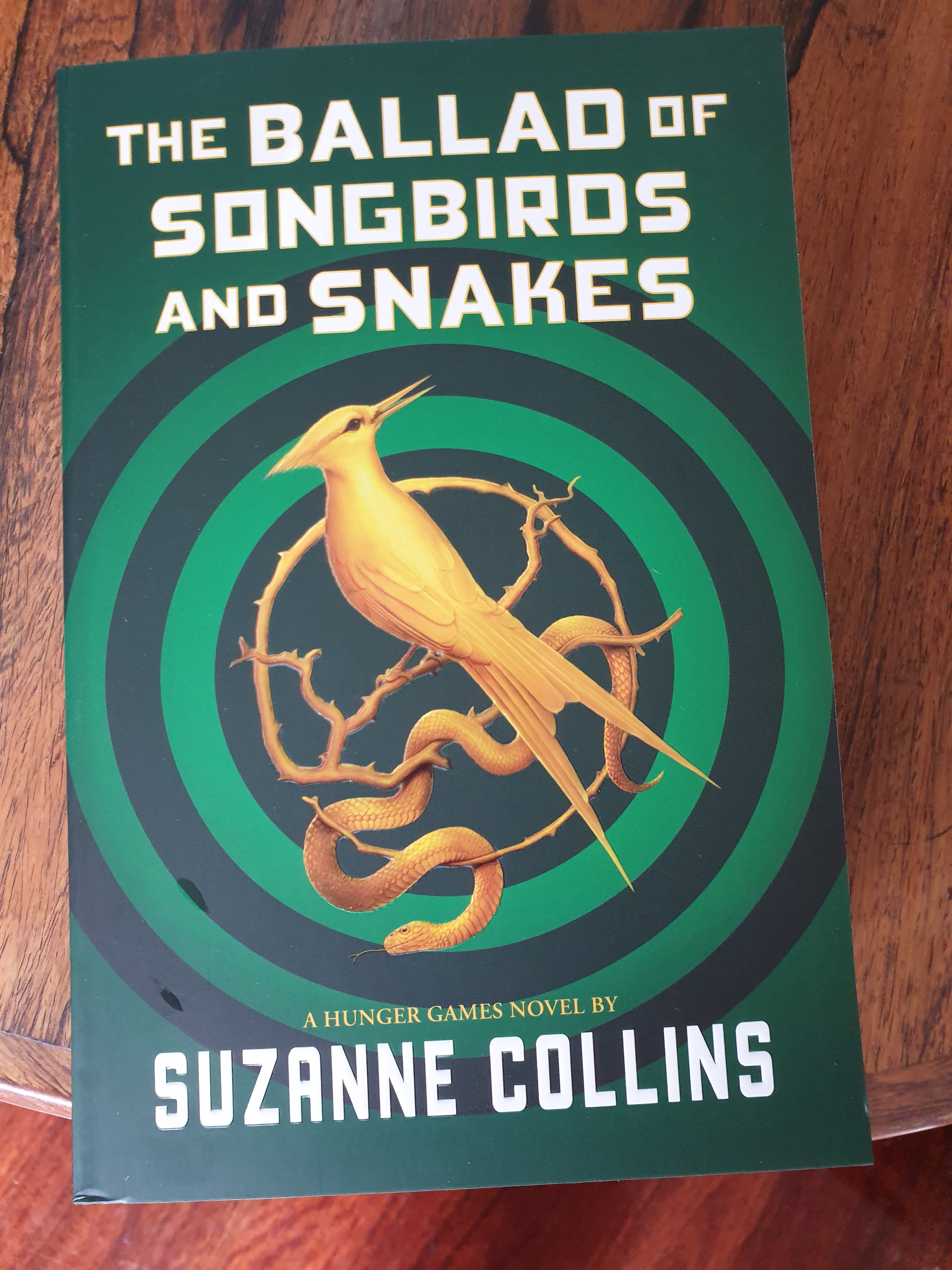
Kudos to Suzanne Collins for ignoring commercial imperatives and writing a Hunger Games prequel the fans will hate, not filmable as a blockbuster. Though it could make a terrific art-house film.
This prequel is set 63 years prior to the first of The Hunger Games trilogy: 517 pages thrashing out the Hobbes vs Locke Enlightenment philosophers’ debate – human darkness vs human optimism – through the making of a dictator, the unmaking of a man. I’ll attempt this blog post without spoilers. The biggest ‘spoiler’ is a given: Coryo Snow, a boy of promise, must in the end be Coriolanus Snow, the sociopath tyrant.
My sister and I both hated that sentimental, golden glow epilogue tacked onto the end of The Hunger Games film trilogy. We saw it as a betrayal of the novels.
“The point,” I glowered, “Is that heroes, if they survive, are maimed for life, irrevocably damaged.”
“No,” said my sister, who always knows best. “The point is that heroes become monsters. Heroes are killers. They can’t escape that.”
Coriolanus ‘Coryo’ Snow is the ‘hero’ of The Ballad of Songbirds and Snakes, a title explicitly referring to the Americana murder ballad tradition. He’s a ‘hero’ who over the course of his narrative becomes an anti-hero and ultimately, long before The Hunger Games trilogy kicks in, an antagonist.
In the C17th, philosopher John Locke contended that human beings are born into the common condition of humanity (which for him, encompassed a concept of human rights), but that each individual is born a “blank slate”, with the capacity to make moral choices that determine the kind of human they become: self-authored. Thomas Hobbes, in contrast, argued that human nature is base, brutish, a reactive amygdala wired to fear, aggression, violence, self-preservation: self-interested (no, Hobbes did not pre-empt neuroscience, my amygdala reference is anachronistic).
The Hunger Games is a battlefield where the ideas of Locke versus Hobbes play out. In Collins’ Hunger Games novels, every person fights through their own Hunger Games, in their own arena. The slogan is “May the odds be ever in your favour”. But when the game is skewed, and the odds are never in your favour, the outcome can only be Hobbesian.
The boy Coryo Snow starts, as all Hunger Games contestants do, with a set of resources (weapons), and a set of deficits. Coriolanus is the 18 year-old son of a dead war hero, from a patrician family whose antebellum wealth was immense. Their fortune was based on munitions, with manufacturing and research bases in District 13, nuked out of existence during the war.
Coryo was an 8 year-old orphan when the rebels were defeated. His people, in the Capitol, were ostensibly the ‘victors’, but his cohort grew up under blanket bombing, with constant gruesome death, starvation, even cannibalism. They endured their own “hunger games”, desperately trying to stay alive on the thinnest gruels, sparsely dished out. Even 10 years post-war, the streets are blocked by rubble, the poor still go hungry (very hungry), and the final year students at the Capitol’s elite Academy bear a huge weight of expectation to revive the Capitol’s prosperity. They also carry an immense legacy of bitterness.
Coryo has social capital (he is part of the elite), but no actual money. If the Snow family is to recover what he sees as their rightful place, he must attend university. If he is to attend university, he will need scholarships. He is battling for The Prize. The final year of schooling is an arena in itself.
Coryo’s personal capital (resources) include an exceptionally astute strategic mind. He grasps situations quickly, with clarity, and can formulate swift, effective responses. Excellent survival skills. But if you see things with clarity, and can see where they’re headed, and what it takes to survive is an unethical action, or actions, are you morally culpable? Is it more worthy to act in line with idealist morality and die?
What if the idealists by their actions endanger others, people who owe them nothing (unless altruism is a human absolute)?
Or: is seeing situations with clarity and acting pragmatically, in one’s own self-interest, the definition of sociopathy?
Coryo’s personal capital also includes charm. He’s an actor. He is constantly alert to the impression on others his behaviours make. Is he irrevocably two-faced, to be condemned, or is that good sense? What consequences follow being too honest, too open?
It’s important to register that although this novel is not told in the first-person, directly in Coryo’s voice, everything is presented from his perspective. That’s terrific, in that Coryo is awake to most of the information salient to his survival. But it is a self-justifying perspective. And he has pronounced blind spots.
Given how astute he is, and how obvious some of the information he filters out is to a reader, what determines these blind spots? Is it simply that he doesn’t want to see some things? Is this guilt? Or, again, is it sociopathy: he screens out distasteful data that serves his survival?
He’s certainly obsessive.
It’s fair to say Coryo is deaf to poetry and does not understand music. That’s a shame, as the person he believes he loves is a poet and musician. We have no access to who that person is beyond the poetry and music they articulate, because Coryo is stumbling blind there.
What he does know is this: ‘She’s onstage. You’re onstage. This is the show.’
The Capitol’s chief of weaponries research tells him, “You’re good at games. One day you’ll be a Gamemaker.”
The thought had never crossed his mind. […I]t didn’t seem like much of a job. Or like it required any particular skill, tossing kids and weapons in an arena and letting them fight it out. He supposed they had to organise the reapings and film the Games, but he hoped for a more challenging career. “I’ve got a great deal to learn before I can even think of that,” he said modestly.
Coriolanus is nothing if not a fast learner.
That’s his dilemma: what is he – nothing, or a fast learner?
Afternote: A 1799 poem by William Wordsworth is a key device in this narrative. It’s worth noting Wordsworth started out as a youthful radical liberal and aged into a conservative. I think there’s a point there.






 Elly McDonald