Elly McDonald

Writer


1 Comment

Lucrezia, Elizabeth and Sansa

Blood & Beauty / In the Name of the Family – Sarah Dunant
The White Princess – Philippa Gregory
Game of Thrones (TV series) – George R.R. Martin, David Benioff, D.B. Weiss

Lucrezia Borgia lived an extraordinary life, but really, who’d swap? Who’d be a Renaissance princess for real?

Born in 1480, the illegitimate daughter of a prince of the Roman Catholic Church, Pope Alexander VI, Lucrezia was twice engaged before age 12; married (to a third fiancé) at 13, divorced four years later, allegedly (but implausibly) still virginal; remarried at 18, widowed by age 20 when her brother had her husband garrotted; married once more at 22, to a duke’s syphilitic son; ten children (and multiple miscarriages) later, dead at 39. Libelled through the centuries as an adulteress, an incestuous wanton, a poisoner.
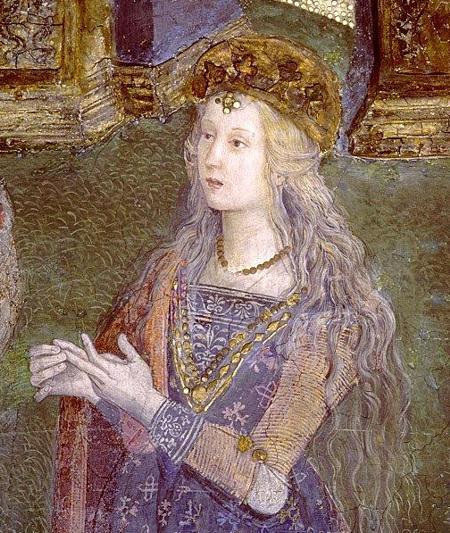
Lucrezia Borgia Elly McDonald Writer

There’s Elizabeth of York, born in 1466, eldest daughter of King Edward IV of England: first engaged at age 3; then engaged to the French Dauphin at age 9; rumoured to be her uncle King Richard III’s intended wife at 18; offered by her malformed uncle to the Portuguese king’s heir; offered by her mother to Henry Tudor, King Henry VII. Six live births, three surviving children (including the future Henry VIII) when she died in childbirth on her 37th birthday.

Elizabeth of York Elly McDonald Writer

Then there’s Sansa Stark. Sansa Stark is a fictional character. Arguably, she’s a composite invention, with elements of Elizabeth of York’s life woven through her story, and a few tangential elements of Lucrezia Borgia’s: Lucrezia’s sister-in-law, from her second marriage, was named Sancia. Viewers of the TV series Game of Thrones will recall that Sansa was engaged to King Robert Baratheon’s heir Joffrey, then married to the dwarf Tyrion Lannister, abandoned still virginal to be bigamously married off to the sociopathic rapist Ramsay Bolton. (Readers of the George RR Martin novels A Song of Ice and Fire understand the narrative in the books unfolds somewhat differently.)

Sansa Stark Elly McDonald Writer

What’s interesting about these storylines is agency.

Were Lucrezia and Elizabeth merely marriage pawns? Were they merely bargaining chips in high stakes political alliances? Or did they have some say in their ‘choices’? Once married, what degree of ‘choice’ did they have in how those marriages – and those political alliances – worked out?

Any historical fiction is always a working through of issues that address contemporary readers. As is all science fiction. So fictionalised imaginings of the lives of Lucrezia Borgia and Elizabeth of York, and fictional creations such as Sansa Stark, are vehicles to explore issues affecting women today: self-determination, autonomy and dependence among them.

Sarah Dunant has written five novels now which explore aspects of women’s lives in Renaissance Italian states. The Birth of Venus (2003) tells the tale of a Florentine merchant’s daughter who aspires to be an artist. In the Company of the Courtesan (2006) follows the career of a courtesan who, after the 1527 Sack of Rome by French armies, rebuilds her career in Venice. Sacred Hearts (2008) concerns a young girl unwillingly interned in a convent as a novice nun. Blood & Beauty (2013) and In the Name of the Family (2017) recount the fortunes of Lucrezia Borgia, through to the death of her father and her brother Cesare’s political demise.

Sarah Dunant scrupulously follows historical fact as best it can be ascertained. Where there is no surviving primary evidence, she chooses plausible speculations, from a feminist perspective. Most of the calumnies against Lucrezia Borgia are not plausible. Consequently, the Lucrezia Borgia Dunant presents is much the Lucrezia Borgia presented by Sarah Bradford in her readable biography, Lucrezia Borgia: Life, Love, and Death in Renaissance Italy (2004) – an exemplary Renaissance princess, a convent-educated patron of the arts well-versed in diplomatic skills.

Lucrezia Borgia 2 Elly McDonald Writer

This Lucrezia Borgia has no say in her first marriage and divorce, no hand in the death of her second husband, no choice in leaving her first-born child, but is actively involved in negotiating her third marriage and committed to ensuring that marriage succeeds. She is not an adulteress, being instead a poet’s muse, in line with poet-patroness conventions of the day. Dunant doesn’t allude to Lucrezia’s alleged affair with her brother-in-law the Duke of Mantua, but the case is well-made for why a canny political operative such as Lucrezia proved to be would reject a sexual liaison. (Besides, Francesco Gonzaga was frequently incapacitated by syphilis, and there were few occasions when the two were in physical proximity; their relationship was mainly a written correspondence.)

Lucrezia Borgia 3 Elly McDonald Writer

Lucrezia couldn’t prevent a husband she apparently loved from being murdered on her brother’s orders and was obliged to collaborate in impregnation after impregnation by a husband with advanced syphilis whose temperament and affinities were poles apart from hers. But their interests coincided: preserving the duchy of Ferrara for d’Este rule in a time of turmoil. As a team, they were a success.

Similarly, Elizabeth of York and Henry VII appear to have made a success of their marital alliance, albeit on very different terms. Elizabeth’s claim to the throne of England, as the eldest surviving child of Edward IV, was better than Henry Tudor’s. (Being female did not disbar her, as the subsequent ascents of Mary I, Lady Jane Grey and Elizabeth I in the Tudor period proved.) It was important to Henry that it be clear he claimed the throne in his own right, by right of conquest, and not as male spouse to a queen regnant, the Yorkist heir. The timing of his coronation, prior to the marriage, reinforced this point. Elizabeth was relegated to queen consort, stripped of political power.

It wasn’t that late medieval English female royals had no formal political influence, as had been argued until relatively recently. Henry’s mother, Margaret Beaufort, was his foremost political adviser, with private rooms adjoining her son’s and prominence in public ceremonies. Her household papers attest to the degree of power and autonomy she enjoyed.

But Elizabeth, the White Rose of York, was acknowledged as little more than a breeder. Little contemporary testimony as to her character and activities survives, other than that she was a most amiable woman, with a russet gown and one blue, fond of past-times such as cards, music and dancing, who loved her siblings, her mother and her children, and also her greyhounds. She grew plump over time. Her son Henry, who was 11 when she died, remembered her as a very pretty woman. She lived away from the public gaze, mostly at Greenwich Palace and Eltham Palace.

For Elizabeth, this was a good outcome. She had grown up as the marital prize for the would-be kings. Her destiny was to be queen of England, and she fulfilled that destiny. Even if she could not exercise power herself, her son would be king, and her descendants future rulers. She survived the downfall of her house, the House of York, the York Plantagenets, just as Lucrezia survived the fall of the house of Borgia to thrive as duchess of Ferrara, mother of future dukes.

Both were survivors – until they weren’t, until childbirth felled them. But they survived their brothers and fathers, and fared better than many might have wagered at the time.
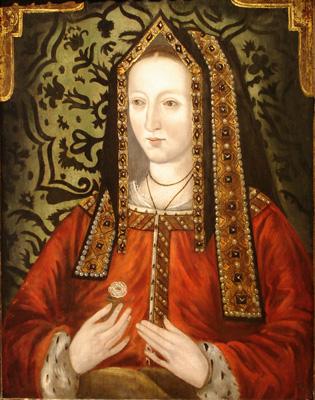
Elizabeth of York 2 Elly McDonald Writer

The central mystery of Elizabeth’s life however remains what she made of the emergence of the man who claimed he was her brother Richard – a man who claimed he hadn’t been murdered in the Tower of London as believed, had survived his older brother Edward, had been brought up in Burgundy, and was in fact the rightful king of England, King Richard IV. This man was supported by European royalty and enjoyed prolonged hospitality at royal courts, marrying the daughter of one of Scotland’s most powerful nobles.

When this man proclaimed himself king in England, he hoped for a popular uprising. It didn’t happen. Instead he was captured. Henry VII’s agents denounced him as an imposter. They said he was really Perkin Warbeck, a Fleming. But Henry treated the imposter well initially, allowing him to live at court for 18 months, albeit under guard and without his wife, who lived under the protection of the queen, Elizabeth.

It is improbable, but possible, that Perkin was born Richard. Did Elizabeth believe Perkin Warbeck was a pretender? Was she unsure, confused? Or, privately, did she recognise him as her brother? Did she believe his wife Lady Katherine was her sister-in-law, or was Lady Katherine, for her, another young noblewoman married for political purposes? Did Elizabeth ever get to have close contact with Perkin? Did she get to see him, to speak to him, at all?

Perkin Warbeck was recaptured after allegedly trying to escape. He was severely beaten and dragged on a wooden hurdle to execution at Tyburn, alongside Elizabeth’s cousin, her aunt Isabelle’s son Edward, the young Earl of Warwick. How did this impact Elizabeth?

The truth is, Elizabeth the White Rose of York, queen consort of England, had zero agency to affect Perkin Warbeck’s fate. Even if Perkin Warbeck was Richard Plantagenet, rightful king of England, and even had his sister recognised him at first glance, there was not a thing she could have done to avert his end. Any hint of recognition, distress or mourning would have been anathema to her husband and to the dynastic interests of her children, and might have endangered Elizabeth herself. After all, her husband – and, after her death, her son Henry – spent years systematically destroying any kin of Elizabeth’s who could be acclaimed as Plantagenet heirs.

Elizabeth of York 3 Elly McDonald Writer

I’m not a huge fan of Philippa Gregory’s novels, despite their immense popularity. But Elizabeth’s powerlessness is poignant as depicted in The White Princess, just as Lucrezia’s powerlessness to prevent her second husband’s murder is poignant – is shocking – as depicted in Dunant’s Blood & Beauty.

Philippa Gregory represents Elizabeth of York almost as catatonic, as paralysed, in relation to Perkin Warbeck. Dunant shows Lucrezia and her sister-in-law Sancia desperately attempting to save Alfonso of Aragon by appealing to a higher authority, her father, the Pope – only to inadvertently leave him exposed and fatally vulnerable.

On Game of Thrones, as at the time of writing we don’t know where Sansa Stark’s story is headed. She’s developed from being a naïve ingénue through manifold manipulations to her current status as an avenging Amazon, intent on reclaiming what is hers. So far, all but one of her immediate family have been killed (with one resurrected, and one transformed into a three-eyed crow). I don’t know whether Sansa gets to call the shots in her future. But I’m betting she doesn’t die in childbirth.

Sansa, of course, is a fiction.

https://ellymcdonaldwriter.com/category/medieval-history/

Sansa Stark 2 Elly McDonald Writer


Leave a comment

Avon and Servalan, Paul and Jacqueline – memoirs

Call me Jacks – Jacqueline Pearce in conversation [with Nicholas Briggs] Audio CD

You’re him, aren’t you? An autobiography by Paul Darrow

From 1978 till 1981 the British sci-fi series Blake’s 7 was broadcast on TV across four seasons, 52 episodes in all. Blake’s 7 was originated by Terry Nation, who also created the Daleks of Doctor Who fame. He intended Blake’s 7 to be a darker alternative to Doctor Who: Doctor Who for adults. Or a darker Star Wars. It ended badly. I mean that. As a 20 year old fan in 1981, I was so distressed by Blake’s 7’s final scenes that I wrote to the newspapers: Shocked of Kings Cross, Sydney (a neighbourhood where most of us were mostly unshockable).

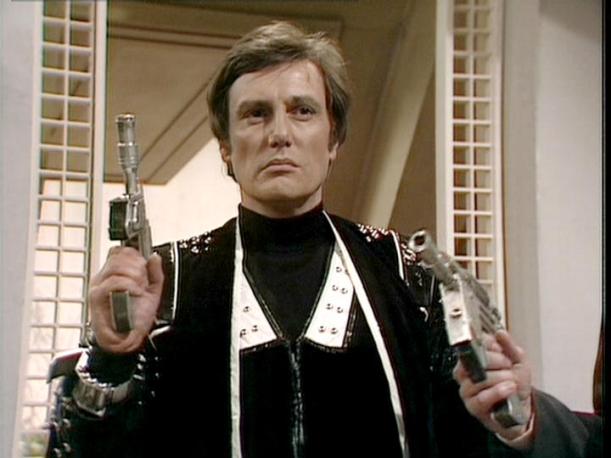
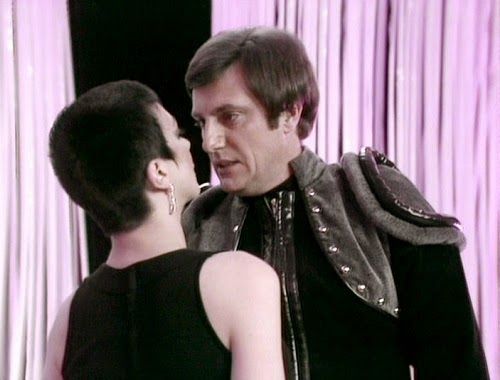
There were two mainstay characters who did not appear in Episode 1, Series 1, and one of these characters was missing – and greatly missed – in that final episode. The other claims the final shot. These characters are the evil galactic Supreme Commander Servalan, played by Jacqueline Pearce, and Avon, first introduced as a cold, self-interested, sociopathic hacker, played by Paul Darrow.

Servalan

The absence of Servalan and Avon might explain why, when I watched a repeat of Episode 1, Series 1 when Blake’s 7 was rescreened in the ‘90s, I could not make out why I’d loved this show so much. Avon and Servalan. They were the drawcards. Tarrant was cute and Cally quite compelling, Vila was amusing and the first Travis had a kind of S&M appeal, but really, for me Blake’s 7 was Avon and Servalan. This I understand was true for many of the series’ 10 million or so (at its peak) viewers.

Servalan, especially, was a kind of perverted role model for me. After a miserable love affair, I cut my hair to a short fuzz, to look like hers. Men wanted to touch the possum fur fuzz on my head. I let them. But I knew I was an alter ego – a lost clone – of the Supreme Commander and that if I chose, those men would be laser blast fragments.

servalan blasts Avon

Having recently re-encountered Blake’s 7, I was curious to learn what happened to the actors in their subsequent lives. I found there is a pop cult industry around the series, a business called B7 and a business called Big Finish, with audio adventures voiced by original cast members and Comic Con appearances. There are autobiographical materials, such as Call Me Jacks – Jacqueline Pearce in conversation (audio CD) and Paul Darrow’s memoir You’re him, aren’t you? – An autobiography.

What did I learn?

I learned that it’s painful to be an actor, that the odds of achieving any kind of success are stacked against acting aspirants, that success once achieved is seldom enough, and seldom sustained, and that the pain of being a has-been and the pain of being a never-was and the pain of finding hollow “success” can be hard to live with.

I learned that Darrow and Pearce are both deeply ambivalent about Blake’s 7, that the 35 years since have seen both struggle with depression and despair, and struggle in other ways. Pearce talks openly, recklessly, about it. Darrow circles around pain and disappointment over and over, looping through themes of ambition and failure, and feelings of anger and envy, till the cumulative effect is of an old actor, deep in his cups, holding forth in a way he hopes is avuncular but in fact comes across as bitter. Not that I’m saying Paul Darrow drinks. I’m talking about how I read his memoir.

Paul Darrow Avon

There are positives. Jacqueline Pearce is painfully open, recounting a tale of talent blighted by mental illness, but her story testifies to resilience and the value of friendships, including a supportive friendship with the late great actor John Hurt. It’s easy to empathise with Pearce’s observations and experiences, and easy to admire her fortitude. Plus, her voice is beautiful, even if her frequent throaty laugh becomes unsettling.

Paul Darrow is an intelligent man and his account of his life attests resilience, too, and enterprise. He writes in short pieces, not necessarily linear chronology, and I wish there’d been a sympathetic editor to hand to help him focus on the interesting questions he raises, and to minimise some of the more indulgent sections, such as his synopses of each episode of every Blake’s 7 series, which could be summarised as “The narratives were crap, the production values trash; if you care about Blake’s 7, the more fool you.”

I don’t think he meant to imply Blake’s 7’s production team, or its viewers, are idiots, but he does imply that, at length. Then he contradicts himself and praises the writers, the directors, the stunt crew, thanks the actors for their friendship and thanks Terry Nation for transforming his life. Like I said, conflicted.

Paul Darrow is an intelligent man. He does raise good questions. Given the plots are ludicrous, the stunts unconvincing, special effects rudimentary and the production values shout low budget, what can account for Blake’s 7’s popularity? This was a show shot on video, not film, shot largely within semi-bare stationary sets (Scene: The interior of a space craft), with quarries and occasional sand drifts for location shoots, and characters who wield what look like hair-dryers standing in for laser guns.

And this: why did audiences relate so strongly to the overt sociopaths, to Avon and Servalan? Why did the sparks of an Avon/Servalan pairing cause salivations? Why, cosmos above, would young women like me imagine Servalan a role model and fantasise about Avon?

Servalan Avon.jpg

Paul Darrow is an intelligent man and in his autobiography he acknowledges these questions. Then, after a half-hearted stab in response (Avon as “a bit of rough”?), he gloomily gives up, as if it’s all too much. Which it would seem it was.

It must be hard, for Paul Darrow, to start out sharing a house with fellow RADA students John Hurt and Ian McShane, and at the height of one’s fame to be touted as a future James Bond (Timothy Dalton got the Bond gig), then to be relegated to pantomime, touring rep (again), and the continuing audio adventures of a character you played several decades back. A character who logic suggests died.

Darrow writes interestingly about typecasting, and he writes about an actor’s need for an audience, for affirmation. He is savagely funny about how he’ll be remembered. As ever, he’s torn, not sure whether anyone will care at all, or whether there’ll be mangled memories and pop culture fan-hysteric tears, or whether some people might consider his career had value. I’m here to reassure him. Paul, you are loved. How could a reader not love an actor who quotes the review that said “Paul Darrow plays Macbeth like Freddie Mercury giving a farewell concert”, and the review that read “Paul Darrow is an actor worth watching, but not in this play”?

It must be hard, for Jacqueline Pearce, to start out as the RADA ‘girl most likely’, directed by Trevor Nunn, hanging out with John Hurt, Anthony Hopkins and Ian McShane (no mention of Paul Darrow), then be ‘demoted’ in the final series of Blake’s 7, omitted altogether from the final episode, then spend most of the next decades with little or no acting work, instead dependent on Housing Benefits and the kindness of friends, with stints as an artists’ life-drawing nude model in Cornwall, and volunteering in a monkey sanctuary in Africa. Plus stints in psychiatric care. And two bouts with cancer.

Servalan Jacqueline Pearce

Live well, Jacqueline.

My own best answer for why Blake’s 7 was loved is this:

In the late ‘70s, the Western world began to understand its supremacy could not last. Throughout the ‘70s there were petrol politics, revolutions, the Irish Troubles, labour unrest, increasing disparity between North and South, and rich and poor. During Blake’s 7’s run, the USA voted out Jimmy Carter and voted in Ronald Reagan. Margaret Thatcher was elected prime minister of Britain.

We weren’t too sure about our heroes – was Thatcher a Servalan? – and we weren’t sure who were the villains (the IRA? Revolutionaries in Iran?).

Paul Darrow points out it isn’t clear whether the crew of the space ship Liberator, the crew who were “Blake’s seven”, were in fact heroes or simply terrorists. He asks, if Blake was trying to lead a popular revolution, why was nobody else rising up? Could it be, possibly, that the Evil Empire was not perceived by its citizens as evil? Could it be that Blake, and his crew, with their talents for destruction, remained criminals even on the Liberator, as they had started out criminals?

In times of change and extreme moral ambivalence the foremost task, possibly, becomes survival. Avon and Blake and the Blake’s 7 crew hurtled through a hostile universe, hunted by omnipresent authorities, unsure of their mission, not knowing who to trust. So you trust the strong man. You trust the sociopath, Avon, because Avon has his eyes on the prize: survival. Or you follow the Supreme Commander, Servalan, because Servalan is also a survivor, and her will to power is second to none.

Pearce and Darrow were good at playing survivors.

Don’t be fooled by that soft velvet fuzz. Servalan will kill rather than be killed, and Avon will, always, be the last man standing.

avon and guards


Leave a comment

Conquest Trilogy: Shieldwall (2011) by Justin Hill

shieldwall-justin-hillShieldwall is a welcome surprise. It’s a serious – and successful – attempt at telling the hero tale of Godwin, father of Harold, last Anglo-Saxon king of England, in a style that’s consciously, but not crudely, an homage to the genre of Germanic heroic lay. It’s elegiac, lyrical, grand, high-minded; centrally concerned with honour and male friendship, fathers and sons, duty, war and death.
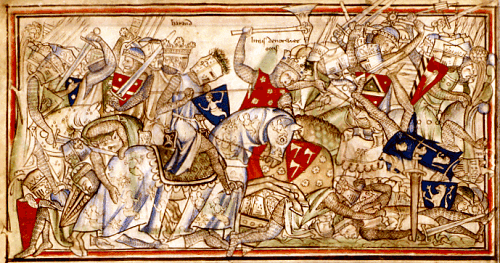
There’s a lot on the historic record about Godwin, mostly about his adult life. We know he was an Anglo-Saxon magnate of extraordinary wealth and power, right-hand man in England to King Knut the Great, the Danish King of Denmark, Norway and England. We know he was over-endowed with sons who proved troublesome even by C11th standards. We know he came from relatively humble beginnings, a thegn’s son, and was a pubescent hostage in the court of King Ethelred the Unrede, who exiled Godwin’s father.

History however is written by the winners, and three of Godwin’s sons, including King Harold, were killed at the Battle of Hastings when Duke William of Normandy won his cognomen William the Conqueror. Understandably, chroniclers in the Anglo-Norman period were not kind to Godwin, damning his and his dynasty’s ambition. About how Godwin rose to such heights in the first instance, gaining Knut’s trust, we know little, although we can surmise he was indeed ambitious. Given the violent and uncertain politics of the period, he was also almost certainly outstandingly able, intelligent, and brave. He very likely demonstrated qualities Anglo-Saxons admired and respected: a war-leader, a man of his word, loyal to his king, a just man (within the understandings of ‘justice’ of the time).

[When I say “we”, I am inviting you to agree with me, and I should admit now I am not an expert on Anglo-Saxon England. I do have an academic background in Early Medieval Celtic Literature, and Brythonic Literature, and a reader’s appreciation of the Anglo-Saxon period.]

Justin Hill represents the youthful Godwin in precisely these positive terms. The historic Godwin was likely brutal, ruthless, and feared, not only by his enemies; we see less of this aspect in Hill’s young Godwin. Hill’s Godwin is purely hero.

Arguably, though, the true hero of Shieldwall is less Godwin than the king Hill assigns him as blood-brother and soul-mate, the Anglo-Saxon king who proceeded Knut: Edmund Ironside. The Godwin of Shieldwall may be the adornment, the setting, that better shows off the ‘jewel in the crown’, the young Edmund. Almost forgotten in the popular imagination, Edmund’s life is as courageous as Alfred the Great’s, and well deserves to be retold now.

Some novels within the contemporary genre of Viking and Anglo-Saxon stories are gratuitously and sadistically violent, and violently misogynist. Hill’s tale doesn’t shy away from strong violence, and the extended battle sequences are informed by forensic research on wound marks on skeletons of men killed in early medieval battles. But he doesn’t indulge in the almost pornographic dwelling on brutality that some authors do. (Of course, some authors might argue that the world of Anglo-Saxons and Vikings was irredeemably violent and misogynist; I reply, an author chooses the world they write.) Although he depicts an earthy milieu, his nobles admire their noble wives, sometimes even love their sex slaves, and treat their dependents decently.

We know peasants – and slaves – suffered severely. Hill introduces characters intended to represent the experiences of the poor and powerless, and some of these characters die base deaths. But the nature of the heroic lay is that it memorializes a hero, high-born, and is aristocratic. Its focus is the lives, loyalties, betrayals and deaths of men who wield swords with precious hilts and who wear armbands gifted by their lord, who sing sad songs of the deaths of kings.

I loved Shieldwall. Can’t wait to read the next two novels in Justin Hill’s trilogy.


Leave a comment

Conquest Trilogy: Viking Fire (2016) by Justin Hill

viking-fire-justin-hill-elly-mcdonald-writer

Harald Hardrada’s true-life story is epic. Parts of it are recorded in a range of historical sources, including Snorri Sturluson’s Saga of Harald Hardrada (“Hard Ruler”), and all of it is extraordinary, larger than life, as was the man, famously described as “taller than most men” and therefore requiring a larger burial plot.

It’s an epic that cries out to be told and re-told.

Viking Fire tells Harald Sigurdsson’s story for contemporary readers. It’s the second novel in Justin Hill’s Conquest Trilogy, which began with Shieldwall (also excellent).

I first met Harald Hardrada through another historical fiction trilogy, about a different – and fictional – Viking named Harald Sigurdson (sic): Henry Treece’s Viking Dawn, The Road to Miklagard, Viking Sunset. Reading Treece’s Viking Trilogy as a child in the 60s led me to Treece’s fictions Last of the Vikings and Swords from the North, both about Hardrada.

More recently I’ve re-traced Viking voyages from the frozen north through Rus through Pecheneg lands to Byzantium with Robert Low’s Orm and his men, in the Oathsworn series, starting with The Whale Road. Orm’s journey is a descent into darkness: savage, nihilistic.

Justin Hill charts similar geographical territory in his life of Harald Sigurdsson, King of Norway – Harald Hardrada, Last of the Vikings – but Hill’s novel has a different project. Framed as if recounted by a Saxon archbishop, as told to him by Harald, it’s ambitious and literary and seeks to situate Harald historically as a ruler with wide experience of the known world’s great powers, a Christian king who recognizes the need for the peoples of the North to transition from raiding and subsistence agrarian communities to trading-based economies with centralized institutions and a literate administrative class.

Hill suggests that had Harald (rather than William) succeeded in conquering England in 1066, England might have remained part of a Scandinavian sphere post-Knut, with its Saxon and Dane traditions respected and evolving to meet the needs of a new epoch. Instead, the Normans led by William defeated Harold Godwinsson at Hastings, the Harrowing devastated English lands, Saxon elites were destroyed or absorbed through marriages, Norman institutions were imposed, and Anglo-Norman England became a domain of mainland western Europe, its history for the next 500 years (or more) inextricably and bloodily entwined with that of the French kingdoms.

Ealdred the Archbishop writes: “For a king more famous for his prowess as a warrior, I expected a bluff and ill-educated man, but I was surprised. He talked expansively of his life, and he was not the brute that we had feared. He was learned, and wise, and had not wasted his time among the Greeks.”

Indeedy. As ‘Araltes’ the Varanger (a bodyguard to Emperor Michael IV), Harald played a key role in the bloody politics of C11th Byzantium, travelled in the Emperor’s service to Jerusalem, and fought in Sicily and the Italian peninsula. He amassed a fortune, enabling him to return in style to Norway, which he’d left as a 15 year old fugitive from the Battle of Stiklestad, where his half-brother King Olaf (St Olav) was killed.

It’s an astonishing life narrative that seems to argue that which doesn’t kill makes stronger. Or that fortune favours the bold. Or simply that being smart and strong and brave and lucky is a winning combination.

Justin Hill tells Harald’s tale superbly. His writing here is confident and entirely effective.

I particularly like that Hill allows his women characters dignity. There are serving women, nursemaids, empresses, queens, sex partners, wives and mothers – but he’s made the effort to acknowledge each, to create characters, and not to exploit them pornographically. Yes, women in this period were often sexually exploited, sexually abused; but women also had respected roles, sometimes important roles, and as individuals were loved and admired, as sex partners, wives, mothers, daughters and sisters have been often, throughout the ages. Reading other Viking novels we might sometimes forget this.

Read Viking Fire. Read Shieldwall. Read the third novel in the trilogy, when it comes out.

On a personal note, as I write this, and as I read this novel, I am nursing my father in his last days. Justin Hill’s novel plucked me out of my small world, and took me somewhere else. Thank you for that.