Elly McDonald

Writer


Leave a comment

After viewing Philippe Mora’s film Monsieur Mayonnaise (2016)

Monsieur Mayonnaise: Philippe Mora’s colour-saturated documentary/memoir/graphic novel/cartoon about how his parents Georges and Mirka survived the Holocaust to introduce European bohemian culture to post-War Melbourne, Australia.

And how Gunther Morawski became Georges Morand then Mora then Monsieur Mayonnaise then Georges Mora; or, how Gunther Morawski became a Resistance hero, father substitute to Jewish war orphans, people smuggler, and impersonator of Catholic nuns (in company with best mate Marcel Marceau).

Some of my responses:- with apologies to Philippe Mora and his family for details I’ve recalled wrongly or that should have been included but are not. I hope the Mora family will forgive me for borrowing some of their images and artwork for this blog.

[SPOILER ALERT: If you plan to see Monsieur Mayonnaise this response might be best read AFTER viewing. On the other hand, it’s the Holocaust – you know how that unfolded. Don’t you?]

monsieur-mayonnaise-hitler-book-burning

Artwork by Philippe Mora for his graphic novel Monsieur Mayonnaise

One morning Leon Zelik left his Paris apartment to buy a newspaper. While he was out, soldiers arrived and took his wife and his three daughters, Mirka, Madeleine and Salome.

The women were herded onto a train along with 1000 other Jews, mostly women and children. They were terrified. As the train rattled along, Mme Zelik and Mirka, her eldest daughter, peered through the wooden slats of their crate-carriage, strained to identify signage at train stations they passed.

The mother had had the presence of mind to grab a sheet of paper, a pen and an envelope from their apartment as they were taken. Now, she wrote the names of each train station in sequence. She folded the page into the unstamped envelope, which she addressed to her husband, Leon Zelik, at their street address.

She directed Mirka to drop the sealed envelope through the crate cracks as the train slowed. Mirka was frightened it would blow back onto the tracks.

They were disembarked at a massive holding centre. Four days before their contingent were scheduled to be shunted to Auschwitz, guards came and released them. As Mirka looked back towards the camp she saw the other detainees crowded against the fences, the children big-eyed, watching the Zelik family retreat to freedom.

In later years Mirka said the big eyes in the faces of the doomed children were the genesis of the angel children she painted throughout her life. She said the guilt pained her. Telling this, she cried.

Someone had found the addressed envelope, stamped it, and mailed it to Leon in Paris. From the list of train stations, Leon worked out the camp where his family were held. He convinced a clothing manufacturer to request that the Zelik women be released on the grounds that the mother was a required worker manufacturing German army uniforms. A lie, but it worked.

In later years, Mirka thanked that anonymous person who found her mother’s letter, every day, life long.

Mme Zelik, Mirka, Madeleine and Salome were the only survivors of the Jewish detainees on that transport. I have/had a mental blank on The Mother’s name. Wiki says she’s “Celia (Suzanne)” but in his film Philippe Mora refers to her by what I think must be a Lithuanian petname or diminutive.
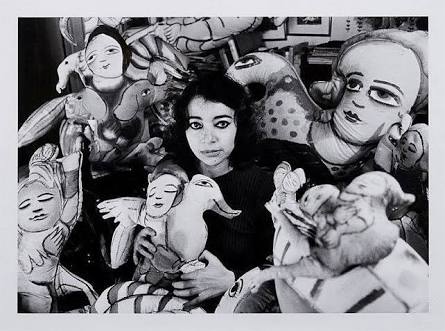
monsieur-mayonnaise-mirka-mora-with-angel-children

Mirka Mora with angel children

There’s a sequel: by chance Leon met a French farm worker, a Christian, who offered the Zelik family sanctuary. In his village was a house locked up while its owner was a prisoner of war. The Zeliks spent 2 1/2 years there. The Frenchman’s daughter says her father never questioned that providing sanctuary was the right – the only – thing to do.

I won’t recount Georges story here. I can’t get his story out of my mind, and have been telling it to almost everyone I meet. But every time I tell it, I cry, and the people I tell it to cry too.

Suffice to say there’s a 92 y.o man on film who says he became an eminent New York child psychiatrist because Mora and his Resistance colleagues saved his life, because Mora cared, and because he wanted to be like Mora: to save children. Even if it meant dressing up as a nun and trekking Jewish war orphans to the Swiss frontier, a la The Sound of Music. In company with the famous mime Marcel Marceau. (No, even in New York none of this is required of child psychiatrists. This is what French Resistance operative code-name Mora did.)

monsieur-mayonnaise-georges-mora-philippe-mora

Georges Mora clips his son Philippe’s hair

In Philippe Mora’s film he visits a museum memorializing child victims of the Holocaust deported from France (not the famous Holocaust Museum in the States – I googled but could not identify this museum). The interior walls seem to be lit with a low golden glow and have what appear to be timber vertical divides and, less prominent, horizontal divides, so that the walls suggest a panel of spaces for portraits or icons. Many of the spaces are filled by photographs of children who died, with their name and (I think) age. The spaces left empty are ones where no photograph has been located. I believe in this museum there are 6000 framed spaces.

Aesthetically it’s beautiful. Emotionally, it’s devastating.
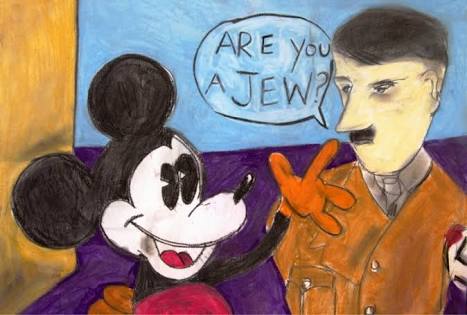
monsieur-mayonnaise-hitler-and-mickey

Artwork by Philippe Mora for his graphic novel Monsieur Mayonnaise

My father shocked me today when he asked if pogroms predated Hitler. He seemed to think anti-Semitism started in post-WW1 Germany. I can only think this is cognitive slippage in old age and illness, as Dad, having been a child in the ’30s, went on to be a student of economics, politics and modern history.

Yet knowledge of modern history is vanishing, replaced by Hollywood distortions (Inglourious Basterds), denial, and a galloping cynicism that buys into conspiracy theories and a belief that everything we’ve been told is propaganda.

When I was 22, in 1983, I went to an adult education course where my classmates included 3 older women, post-WW2 Jewish refugees. Two spoke with heavy accents and the third, after 35 years in Australia, barely spoke English at all. Her friends explained she rarely ventured outside the Jewish emigre community.

I asked if they’d encountered anti-Semitism in their early years in Australia.

“Oh darling,” one woman laughed. “No. People here didn’t know what a Jew WAS.”

I suppose part of the problem is when we can’t admit our ignorance, and *think* we “know” the stranger.

Openness to learn is more important than ever. But in a media age, what media do we trust?
monsieur-mayonnaise-georges-mora

George Mora. Monsieur Mayonnaise.

My friend Donna says, “I was married into a Jewish family for 32 years. The matriarch pulled the address labels off of every magazine that came to the house (the goyim see the name and know that is a Jewish household), and no one talked about illnesses or diseases except in very hushed voices (the government takes the weak first)… that was not uncommon in the WWII generation, but they are slowly dying off, and the younger folks have no idea..”

“George Mora’s” two sons had no idea he was really Gunther Morawitz, German-born, medical student at Leipzig University, native German speaker, until his last years; and no idea why he wouldn’t step into a VW or Mercedes-Benz or use Krupp appliances.

When I was at school I had teachers who were Holocaust survivors. Exposure to first-hand witnesses is invaluable. We’re losing them.

Remembering snow (1986)

Rosa says

I remember snow

When I was a girl I lived

in Siberia

There was so much snow so

much

we skated on a river of ice

Mrs Cameron

born Roth

40,916: tattooed in blue

teaches art

forgets

she remembers.

Don’t ask.

But

Mrs Zabukovec

gypsy eyes

teaches German

born Bulgarian

she remembers

being 18

in Berlin

being 18

Russians

she remembers.

Don’t.

She remembers

long rows of blossoms, white-clustered blossoms

so white so

much breaks

down


remembering snow

monsieur-mayonnaise-mirka-mora


Leave a comment

Old Angus (1984)

Every Sunday, he used to stand by the front window and yell abuse at churchgoers. Sometimes he stood on the lawn and shook his fist at them. Directly across the road, a small Roman Catholic church lies meek in the face of aggression, its whitewashed walls shadowed by an Anglican cathedral towering alongside. Old Angus has no interest in the Anglican cathedral; his fight is with the Roman Catholic god.

He knows he’s losing. After a twenty year battle he’s all but yielded sight; now, his being is demanded. Knowing he’s dying, Old Angus resents it. He rages. For hours he debates unhearing politicians – they on radio and television, he in his solid, ancient bed. A spent force, he is unforgiving.

“I’m ninety”, he tells Young Angus. “If I were a cricketer, I’d have to say I’d had a good innings.”

Not being a cricketer, he doesn’t believe it.

Young Angus sits by his bedside and worries, caring so much he can barely listen.

“D’you remember”, says Old Angus, “That tale about Johnny? How you used to tell me about your girls?”

Young Angus, tired, looks blank.

“You remember, lad? I’d laugh at you. You know the one. In Scotland, the son would come to his dad and say ‘Dad, I’ve found me a perfect lass’. ‘Aye, aye, Johnny?’ the dad would say. ‘Father, I mean to ask her to marry me!’ Johnny tells his dad, and his dad says ‘Aye?’ Maybe she won’t have me’ worries the son, and ‘Aye’, says the dad, ‘Aye, aye’… You remember, lad?”

“Oh, aye”, Young Angus reassures him, truthfully. “I wanted to marry Beth, and you told me about Johnny. I’m glad you never told me what to do.”

“I thought you’d be disappointed again”, Old Angus sighs, shifting uncomfortably in his sheets. “I thought she’d be scared away by Laura. I though maybe Evie might scare her away.”

“Evie never scared anyone but you”, Young Angus reproves him, rearranging the bed clothes.

In the other bedroom, Beth is dying Emma’s hair with Laura looking on. Emma’s triple image, reflected in an old, three-way mirror, commands all eyes. The girl herself perches stiffly on the bed, her self-conscious, fifteen year-old body stretched regal and long. A scheming princess, arrogant neck destined for the block, she notes with satisfaction the way her hair rests in damp curls, piled up away from her face. (Emma, immersed in vanity’s haze, recalls an incident from early childhood, taunting as she yanked a playmate’s pigtail: “I have hair like a princess”, sneered Emma, “And you have hair like a rat’s tail!” Soon after, her blonde began to darken. Old Angus, gazing down from his superior height and seeing only nutmeg, had tussled the strands, saying “Never mind, lass – not every princess has golden curls”.)

“You look lovely!” grins Laura, and Beth beams back at her. Emma, coppoer-brown and all but naked in sheer underclothes, says nothing.

“Here”, says Beth. “Throw on a dress and go in and show Old Angus.”

Old Angus guesses at Emma’s dislike. The young, he reflects, would prefer not to have to acknowledge old age. Emma shouldn’t have to confront death yet.

“You look just like Evie”, Old Angus tells Emma, who momentarily feels insult and fright. Evie, to her, is a mystery madwoman only referred to in furtive whispers. Emma juts her chin.

“Evie was your age when I first saw her”, Old Angus recalls, disregarding the distance between this child and him. “She was fourteen, and I thought she was beautiful. The boss’s daughter, you know? I had to sweep the shop and the verandah, and I’d loiter outside, waiting to see her come home from school. her father couldn’t stand me.”

Emma remains silent, but she’s listening.

“Well, what was I but trash? And Catholic, too! We were shanty types – Scottish Catholics, and fifteen kids! We lived in a riverside shack that flooded when it rained. We’d eat the fish left tangled in the furniture. We couldn’t read or write. Or the others couldn’t, anyway…

“But I wanted more, and I wanted Evie. She was a dream, that girl! A beautiful, round-faced, round-eyed dream. By that time I owned a store of my own.”

He smiles across at Emma, and reaches out his hand. She takes it awkwardly, not knowing what to say.

“He’s telling you about Evie?” asks Beth, balancing a laden tray as she pushes through the door.

“I was telling her how we first started out, before Laura”, Old Angus says. “Her whole family was against us marrying, but she always had a will, had Evie. I remember years later when we got that car. A terrible contraption, a car – it had me beat, alright! But Evie, she was determined to master it. She took it down to the paddock behind the house (this was when we still had the old place), and she forced that thing to work the way she wanted. It fought! It ran amok all over the croquet lawn. But she got the better of it, finally, and it never gave her a problem again.”

“Yes”, Beth smiles, seating herself beside him and carefully handing him a mug of warmed milk. “Yes, Evie was a brave one.”

“Aye”, says Old Angus, meeting her eyes quickly. “She was brave. She was brave with Laura. It wasn’t like she had a soul on her side.”

“Tell me”, Emma Frances demands. Her initials are E.F.M/, like her grandmother’s were.

“About Laura?” asks Old Angus, spilling some milk down his chin. Beth gently mops his neck with a tissue, mentally dismayed at how fragile his skin is.

“Better not”, Beth cautions, quietly.

“Why not?” The old man turns on her. “Why not let her know? I’m not ashamed of Evie. She was worth a dozen of any other person I ever met.”

“Go on, then”, Beth sighs, and he hunches over his mug, cloudy-eyed stare trained on Emma.

“She was, you know”, he nods. “She was worth a damn sight more than what she got. It’s not Laura’s fault. Laura was born a normal child. It was illness that did it. Illness and doctors. First polio, then meningitis. They put her in plaster. Imagine a child’s legs locked away in plaster, for a whole year! They said it would stop them trembling.

“She trembled worse, and her legs were so stunted she could hardly walk. Couldn’t talk properly either. And something happened to her brain.

“Well, you know country towns, and it was worse back then. People round here didn’t understand. They said Laura being struck down was an act of God, that Evie and I had brought it on our child. They said Evie and I must be to blame. Said it was Evie, acting like a man. Too forward, they said; too bloody ambitious.

“She’d dived into politics, Evie-style. Talking feminism, socialism… ‘isms’ we’d never heard of till then. She aimed to be a town councillor, and women could vote here in South Australia, so she wouldn’t let anyone tell her what was what. Unnatural, they said. The children of bad mothers always come to harm; bad mothers like Evie deserve it.”

“That’s not true”, protests Emma, and Beth – taking in her city-bred, modern daughter – wonders if Emma will develop into someone Beth can point to proudly and boast “Yes, that is the child I deserve”.

“The Church believed it”, Old Angus glowers. His hands shake, and milk splashes. “Laura wasn’t allowed to attend mass. They said she was simple, and couldn’t understand. Like she was a dumb animal. So, that was it between the Church and Evie, for all she’d tried so hard to fit in with those women. She’d worked herself to rags on their goddam charities…

“Restaurants, too – they said Laura and her trembles turned people’s stomachs. The said it wasn’t right to feed her in public, the way she slobbers and sometimes spills her food. But she wasn’t any worse than someone old, and I’m still a person, aren’t I?”

Beth takes the mug from Old Angus’s grasp. There are tears of frustration in his clouded eyes, frustration unexhausted after sixty years.

“It’s okay, Dad”, Beth reassures him. “We’ll always look after her.”

“I gave Evie a rough time”, Old Angus continues, trying to wipe his eyes on a pyjama sleeve. “She was hurt, you know. It made her strange. She got so odd, so set in her ways! She was always stubborn, always fighting. I remember when she found my whisky supply – I’d hidden it in the woodshed, ‘cos she wouldn’t have alcohol in the house. I could have killed her. I nearly did! I chased her all around with a knife for twenty minutes, and Young Angus hid up in the big tree and cried.”

“Young Angus thinks the world of you”, says Beth.

“He was a joy, that one.” Old Angus smiles fondly towards the open window. “When we still had the big house, I used to dress up as Father Christmas every year for the town pageant. All the children would climb on my knee and tell me what presents they were angling after. Young Angus clambers up and whispers he’s hoping for a big hunting knife, for when he goes rabbiting with his uncle Jock. Well, says I, I reckon your dad might decide a hunting knife’s too big for a small boy. Young Angus, he looks at me. ‘You look like my dad’, he frowns, ‘But my Daddy would give me what I want’. And bless him, I did. I always did. We spoil the fruits of our old age.”

That night, Young Angus keeps Old Angus company. Quiet pervades the room.

“How do you want to go, Dad?” Young Angus asks his father, low-voiced.

“I don’t want to go at all”, Old Angus snaps back, somewhere between a laugh and a sob.

“No, Dad, I didn’t mean it that way. The old ones in the family are planning the funeral. They want to know if you’ll do it Church or not.”

“Which church?” Old Angus glares.

“Dad, don’t make it hard for me. They want to see you reconciled. They want to see you return to the faith.”

“I’ll not return till they give me back my Evie, and that won’t happen in this world.” A fierce old man, blind and sunken-faced. He considers a moment, then asks more kindly “What seems best to you, lad?”

“I don’t know, Dad. There must be a compromise.”

Old Angus and Young Angus sit shoulder to shoulder, the old man supported by a pile of pillows. Suddenly Old Angus laughs.

“Yes!” he chuckles. “There’s a compromise of sorts. Next to the church, there’s that new cathedral – the C-of-E number. If we book me in there, we can ring our funeral bells all through their mass, and hold up the pious with our funeral procession! If we’re canny, we can clog up their carpark with our mourners’ carss. That’s having it both ways! Can you do it for me, lad? Can you fix ‘em?”

Young Angus would do, could do anything. He kisses the damp flesh of the old man’s head.

“Aye, aye”, says Young Angus, and hugs his father.

angus-snr-edie_2


Leave a comment

On love. And not being able to speak.

When I left London and came back to Australia I promised myself I’d return for a visit within 18 months. I needed to make myself this promise, or I wouldn’t have been able to leave the places, and the people, I loved.

At almost precisely the 18-month mark, I booked a return Melbourne/London/Melbourne plane ticket on my credit card and flew ‘home’ to London, where I’d arranged to spend a few days initially staying with a friend and her infant daughter. I must have been the worst guest ever: I immediately came down with an ugly cold virus. Everywhere I went inside Evelyn’s flat I trailed cloud-mountains of used tissues, soggy and snotty and seemingly endless. Evelyn insisted this was fine; she said she had a cold herself, and contributed a few snotty tissues to the mountain range in solidarity. I bought an over-the-counter medication containing pseudoephedrine to drain my internal swamps and thought I’d be able to tramp on regardless.

I was wrong. I had a reaction to the pseudoephedrine, manifested as a total loss of appetite, mortifying the evening Evelyn and her man took me out to dinner at a local African restaurant and I couldn’t eat a thing. Then my voice went raspy, and eventually, after I’d moved on from Evelyn’s and was staying as a paying guest in a private home in my old neighbourhood, my voice started cutting out altogether.

I’d arranged to meet one of the people I loved for lunch.

“It’s Elly,” I croaked over the phone.

“You sound like a horror movie monster,” the loved one replied. It was too hard to talk. I let that one go.

At Waterloo Station I stopped at a pharmacy and when my turn in the queue came up, I made pleading eyes at the sales attendant and gestured urgently at my throat. He was momentarily nonplussed, then handed me a medication he thought suited.

“I hope whatever happened to your voice gets… better,” he said, sympathetically.

“Thanks,” the horror movie monster croaked. People behind me in the queue shifted uneasily.

By the time I reached the loved one’s workplace I could barely make intelligible noises. This was unfortunate, as he attempted introductions to various colleagues. They smiled and were gracious; I rasped at them.

By the time we reached the upmarket restaurant my friend had booked, I was reduced to making pantomime faces. The waiter came to take our order.

“The rabbit,” I said. He heard, “Rrr rrrrrr.”

The waiter looked at my friend and raised his eyebrow.

“She wants the rabbit,” said my loved one, completely calmly, as if bringing a desperate semi-mute to lunch was an every day occurrence, and as if he could see no problem whatsoever translating my intentions.

My intentions, as it happened, had been to tell my friend how much I had loved him. I felt defeated.

“What’s wrong?” my loved one asked.

“Rrr rrrr rrr rr,” I replied. Which he heard correctly as, “I can’t talk.”

I looked at him with soggy eyes. You know the tragic face in a silent movie? That one.

I think my friend reassured me that was okay, and we proceeded to lunch as best a pragmatic CEO and a snot-filled silent movie grotesque can in a glamorous restaurant. My vision of us talking, earnestly and intimately, about how we’d felt and why we were not together dissolved in a mist of cold virus microspray.

My loved one assumed immunity as we hugged farewell and I rasped my goodbyes.

“Rrrrrrrrrrrr”, I said, with feeling.

He smiled kindly.

It was somehow unfulfilling.

My plan to declare love was almost certainly foolish. My friend knew I loved him. Or he didn’t. Either way, that should have spoken for itself and been sufficient. There are few things more irrelevant than a love whose moment has passed.

Possibly.

In my blog posts, I’ve spent an ungodly amount of space considering the ethics of when to name names and how to label emotions. I’ve tried to explore emotional bonds: how we form strong feelings for a person; when strong emotions are ambivalent; how we situate those feelings within our life narratives. Sometimes I’ve self-censored, thinking it’s not for me to put words out into the world about particular feelings and experiences, in relation to particular people, especially when those people very likely would tell the story of our shared experiences differently.

In other words: My friend of the London lunch might not have had the ‘L’ word – the four-letter one – in mind in relation to me. Ever. I can’t know because we never directly discussed this. That’s why I’d wanted to speak The Word on this occasion.

As I get older, and as people I love age and die, I find I am getting reckless with words and emotions. Fling ‘em out there. Speak up. Just say it.

Two years ago I wrote a series of blog posts I thought of as my ‘Five dead rock stars’ pieces. They were eulogies for five people, now dead, who at important points in my life were significant to me, about whom I had strong positive feelings. Just say it: these were love letters – they were people I loved.

I’m not saying they loved me. Maybe they did, in differing ways, some of the time, at least. The important point is I loved them.

Some people really didn’t like my ‘Five dead rock star’ pieces. They didn’t think I should co-opt and name other people within my highly personalized narratives. They didn’t think I should name my feelings about those people. As they see it, I don’t have that right.

Maybe.

But the way I’ve come to see it, love is too important to leave unnamed. It’s a mystery to me why one day this other person is just another person, then the realization hits: what I feel is a form of love.

Yesterday, I read an article in a newspaper, an interview with an old friend who has been confronting his formative years and writing about his extremely troubled past. I admired his willingness to try to tell it like it is, to try to uncover his truth. And I realized, I don’t want to wait till this person is another dead rock star to eulogize them. I want to publicly name the place he had in my life, as someone I loved, in my way.

Decades ago, a female friend and I were jaywalking in Kings Cross when we bumped into my troubled rock star friend. We chatted briefly, then we parted.

My female friend turned to me and said, “That was amazing. You lit up like a Christmas tree!”

I did. That was love. I can’t turn it down, or off, or suppress it. It persists.

And halleluljah. Thank God for that. What a gift it is, to be capable of long-lasting, irrepressible, life-changing positive feelings for a person, even if those feelings are not reciprocated or are returned inequitably. It’s a cliché, but love gives meaning to life.

So why am I not naming the loved ones in this piece? And the others who I love, who shaped my life and helped create meaning?

Our lives are now disparate, widely diverged and widely divulged. I guess they know I loved them. Or they don’t. Maybe they do and they’d rather I hadn’t, rather I didn’t. Too bad.

Love shows up and does its thing then settles into my soul. It’s not that it doesn’t dare speak its name. Through life’s inarticulacy, it makes itself understood.

Rrrrrrrrrrrrrrrrrrrrrrrrr

rabbit-02


2 Comments

Statement of poetics (1985)

Poetry and Gender: Statements and Essays in Australian Women’s Poetry and Poetics – editors Davids Brooks and Brenda Walker, St Lucia University of Queensland, 1989, p.57/58

It’s very strange to re-read this after 30 years. I remember I was asked to write a Statement of Poetics for this study early in 1985, in my first term enrolled in English at the University of Sydney. I had no idea what a “Statement of poetics” should be. I knew nothing about gender theory in Literature. I took my draft to my Term 1 tutor, who as it happened was an aspiring creative writer too. She didn’t like me and she did not like my draft. I remember her wrinkling her nose. I also remember that when the writer Helen Garner visited that term, my tutor and a number of students joined Helen for a drink, and I hoped my tutor might introduce us. Of course I should have simply introduced myself. A short while after, Helen contacted me, by handwritten note, requesting a copy of my poetry book, Other People (and other poems). I was thrilled by her interest, and I told her I’d been present that evening at Sydney Uni. Helen wrote back saying it’s frustrating how often people she hoped to meet tell her they’d been somewhere in her proximity but had been too shy to introduce themselves.

The other thing I note is my bullshit. My poems did not have an “male/female, overtly sexual context”? My relationships with women and family were “more complex than my relationships with men”? I wrote “most often about female friendships”?  Perhaps. For the record: Other People (and other poems) was memoir.

Nearly all my poems are records of conflict; I write as a means of clarifying emotion.

The only reader I initially had in mind was me; for years I never considered poems of mine might be publishable. I was writing highly-codified, deceptively simple lines that read like printed lyrics to songs. The music was built-in: I relied on rhythm, and rhythm is still the lynchpin of my style. I actually regard some of my poems as songs for the inner-ear, though I’m aware that rhythms that seem to me insistent are not always obvious, comfortable or even apparent to some readers.

Repetition is another hallmark of my style. I like to play with a word, and its puns and variations and rhymes, in such a way that several meanings may be suggested. Punctuation in my poetry is a guide suggesting mental pauses like musical rests of varying value. I seldom use conventional punctuation, believing it forces too narrow a reading. Ideally, multiple meanings should bounce off each phrase. Lines often have a particular meaning taken by themselves that adds another dimension to their sense in the context of the whole sentence or verse. I like that. I think of it as texture, as verbal cross-weaving. It’s also an intellectual game, a form of self-amusement like a cryptic crossword. I once wrote a six-line poem in which the lines and phrases could be read in any sequence and still convey sense.

However, until quite recently it never occurred to me these games might be accepted as ‘real’ poetry. Real poetry, I thought, was based on metaphor. More abstract, more structurally complex and more dense, real poetry was rife with adjectives. My poetry became very wordy, which in itself I don’t consider a fault – writing is, after all, about words – so long as the words are used to effect. I do think, though, that in poems written during this phase I was cramming in too much, too clumsily.

Because I feel strongly about their subjects, my poems often have an impulsive, obsessive quality. Where poetry is concerned, I’m just not interesting in exploring anything but the politics of personal relationships. The relationships I have with other women and with my family have proved more complex than my relationships with men, so I write most often about female friendships, current and past. These ‘friendships’ have often been problematic, ambivalent; the poems are correspondingly ambiguous. (Some poems that may appear to address a man in fact involve a woman.)

Up until now, stalemated power-struggles have been the dominant recurring theme, and the image of the doppelganger stalks through much of my work. The doppelganger reflects a too-close identification with my perceived (female) ‘Enemy’: almost an exchange of identity. The doppelganger might be the Enemy as Self.

The doppelganger stares back from mirrors. Frequent references to mirrors in my poems are not intentional symbolism, but now I’ve become aware of them I’m sure they relate to a childhood conviction that mirrors are the bridge between the land of the living and a phantasm zone. Quite a few poems of mine are re-lived nightmares, or slip midway into nightmare sequences.

A sense of displacement, of dislocation, is also something I’m increasingly aware of as an element in my writing. The poems’ subjects are usually an Outsider – or an outcast, a misfit who’d choose to be accepted. More often than not, the Outsider’s survival is in jeopardy. The context is hostile, unknowable: strangers, people not recognised, mistaken identity and identity exchange recur.

These recurring elements have not been consciously endowed with significance, and I don’t fully understand their implications. Explicit meaning is not a high priority; my poems are not plotted in advance. When I sit down to write, all I usually have is a mood demanding expression. I may have a character, a specific situation and perhaps a key phrase or metaphor, but for the most part the first draft resembles automatic writing. I write till the words take on some kind of form, and then I examine what may have emerged. Invariably these days it requires re-working, but the first draft is the model.

I hope my work reads as distinctively female. Its focus on relationships in other than a male/female, overtly sexual context and its concern with inter-personal nuances are not, to my mind, typical of male writing. For me, poetry is close focus. I believe there are infinite kinds of feeling, forming all degrees of human bonding: variation on feeling seems to me a subject demanding close examination.

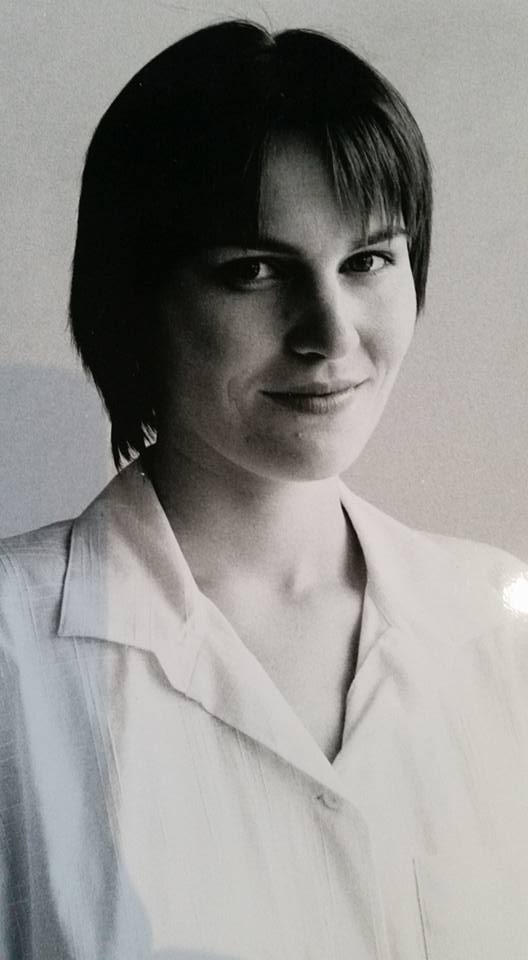
Elly_McDonald_Writer Ian Greene headshot 1985

Headshot taken for inclusion in poetry anthology 1985 (pic: Ian Greene)


Leave a comment

Fire Steps (excerpt from the Lenny novella July 2012)

“That’s a Storyteller’s story,” says Chapin admiringly. “Is it yours?”

“Thank you. My mother’s,” I respond.

“You know,” Chapin says, “I don’t think Milos set a trap. I don’t think there are Servants near. I’ve visited him in Fourth Division villages and if that was his plan he could have had Servants take me then.”

“There are four of us now.”

“Yes, but he couldn’t have known that. He only expected me. And the Servants last night had a chopper. If there was still a chopper in the area it’d be on top of us by now.”

We are crouched alongside a rooftop gable, wedged into the cornice, clutching the decorative tiling that lines the gable’s dorsal fin. Roberto and Roman are metres away, pressing back into the elbow of a parallel gable. It’s precarious, but thanks to the tiling being newly installed, and the structures newly built, I’m confident it’ll hold. That might be the only thing I’m confident about.

“Milos is right though. If we go, we’ll die. There’s nothing for us out there.”

Chapin narrows his eyes and shakes his head dismissively.

“Why are buying into what Milos says? You say I was naïve, but there you go buying a story from an amateur. He wants us to believe we have no options.”

“So what are our options now?”

Roberto is listening to every word. Roman is scanning the skies. I note that: not the streets, the skies. Chapin notices too.

“I say we pause here for a short while. Milos wanted to demoralise us. I say we tell stories till we remember who we are.”

“Tell stories?”

“You know, that thing we’ve been doing since before we could crawl? I say we sit here on this roof, with nothing but birds between us and the clouds, and tell stories to the open sky. It’s been years of deep forest and grey woods. I want to tell a story to the sun.”

Roberto breaks into a beaming smile. It’s crazy, but it’s true to us. I like the plan.

“What will your story be about?”

Chapin is smiling too, now. He looks remarkably relaxed. We’re mad, us Storytellers. Mad and dangerous.

“Well, you told a story of water and air. How about my story be fire and earth?”

I nod. “How about it? Go right ahead.”

 *

A warlord had a mighty host. His hall was the biggest hall ever known. The main table on the dais seated one hundred warriors, with one hundred maids in attendance. The length of the hall was filled with tables, and every table was filled with warriors, with a maid to attend each warrior individually. The warlord was wealthy and known to be generous; his fame had drawn warriors from every corner of the world, from the tiger lands to the south, to the dragon lands in the west, the turtle lands to the north and the snake lands in the east.

Their armours were of every type: some were lacquered leather, some buffalo or rhinoceros hide, some were disks of bronze stitched together with leather thongs, and some were made of multiple fine layers of paper, capable of stopping arrows. Each warrior had a weapon of choice. Most had a halberd, a long staff with a spear-tip at one end, a hatchet to one side – a hook on the back of the axe-blade could be used to unseat horsemen. Some had a sabre mounted on a long staff, or simply a sabre. There were longbow archers and crossbow archers and cavalry archers. There were broadswords and the finest weapon of all, the long silky blade forged by the great masters, two softer layers of steel surrounding a hard inner core. The softer outer steel makes for resilience, while the hardness at the centre keeps the edge sharp. All of these weapons are murderous, and all of these warriors deadly.

Every night the warlord and his warriors feasted on game in the great hall. Every day they hunted or played war-games. Other lords petitioned the warlord for the use of his men as mercenaries, so always contingents were coming and going, making war, bringing back the spoils.

One day a man came from the west requesting an audience. He was tall and thin, and around his head, shoulders and upper torso was wrapped a red scarf that covered all his face, except his eyes, which were burnished bronze. The man had no weapon except a knife. His knife attracted great interest: it was long, with a single-edged blade that curved forward, the opposite of a scythe. Like the swords of the masters, it was forged ingeniously, softer steel on its back, for resilience, hard steel on the cutting edge. The hilt was slimmer than the blade and was covered in gold embossed designs, which might have been writing.

“It’s a magi,” the men muttered, but the warlord granted an audience.

“What is it you want?” the warlord asked the magi.

The magi bowed low.

“Great lord,” he said. “I come from a land a long way to the west, but even in our territories your armies are harassing peoples who are under our protection. I ask you to stop.”

“To stop?” said the warlord. He didn’t know which territories the man could mean, or which peoples, but the possibility of simply stopping an offensive action, just for the asking, had never occurred to him.

“Stop,” repeated the magi.

“Why would I do that?” the warlord asked, his combative instincts rising.

“To stop would further your prosperity. To continue will bring you ruin.”

“I cannot believe you are making threats.” The warlord really meant this. “Do you have no understanding of protocol? Do you have no common sense?”

“I understand the protocol of civilised lands. Here, to you, I must speak direct.”

The warlord was incensed. “Seize him!” he yelled to the men nearest the guest.

The men made to rise but as they did, they burst into flame. A roar went up across the hall, but no-one moved. No-one except the human torches, staggering into each other as they burned.

“I will return tomorrow,” the magi said. “Think on my request, and come up with a better answer.”

Then he turned and walked out of the hall, each foot-step marked by a burst of flame.

The hall was in uproar. It took many minutes to restore sufficient order for the warlord to be heard.

“This is outrageous!” he shouted. “Tomorrow when this Fire Steps charlatan returns, we will receive him in the manner he deserves!”

So the warlord and his council made plans for Fire Steps’ return.

Sure enough, part-way through the feast a tall figure stepped through the great double doors. As instructed, the men let him pass.

“Are you ready to accede to my request?” the magi asked. “Will you stop harassing the plains peoples of the west?”

“Absolutely not!” screamed the warlord, and on the word “not” a bank of archers with curved horn-bows amassed to the right of the dais let fly their arrows. But as the arrows reached the peak of their arc they burst into flame, just as the men had. The flaming arrows fell on tables throughout the hall, setting multiple small fires the warriors attempted to douse. Sounds of shouting mixed with maids screaming.

The magi stood motionless, his eyes fixed on the warlord.

“Bring back your hosts from the plains to the west,” he ordered, and everyone present heard it as an order. “I will return tomorrow to hear your answer.”

This time as Fire Steps wheeled around towards the doors, warriors fell upon him, but every weapon turned on Fire Steps burst into flame, causing the warriors to drop their swords and halberds, their sabres and daggers, frantically beating out the fires instead.

“This has to stop,” the warlord growled. The warlord and his generals conferred.

On the third night, the warlord’s warriors had drawn up in battle-lines. The tables – those still intact – had been pushed back against the walls. The women were expelled to the smaller dormitory halls.

“I don’t think this will work,” said a young boy helping fasten the clasps on the warlord’s armour.

“You don’t?” said the warlord. The boy was his grandson, and he liked the lad.

“No,” said the child. “He’s already shown twice over that anything you throw at him will just burst into flames. If we launch a full military action against this man the whole hall will go up.”

“I’ve thought of that,” his grandfather replied, indeed, thoughtfully. “But we can’t let him get away with insulting us – insulting me – in the great hall of power. He must be punished.”

“One thing at a time,” said the boy. “If he can’t be punished, he must at least be stopped.”

“Do you have any better ideas?” his grandfather asked.

“Let me try,” said the child. “Before you let loose your armies, let me give it a go.”

So that night when Fire Steps pushed through the great double doors, in front of him he saw the entire forces of the warlord, arrayed as if for battle, and at the very front, standing alone, a boy, unarmed.

“Stop!” said the boy.

The magi stopped.

“That’s a good start,” he conceded, going down on one knee in front of the child. “You have made a reasonable request. Now I make my request of you.”

Turning to where the warlord stood, he asked again, “Will you stop harassing my people?”

“I speak for my lord,” the child said quickly.

“That’s an even better step,” Fire Steps said, approvingly. “Two sensible responses. I am encouraged. But I thought weapons speak for the great lord?”

“Weapons only speak the language of war. It takes a man or a woman to speak words of peace.”

“You are a remarkably wise child,” the magi smiled. “Are you born into the wrong tribe?”

“What will happen if we do not stop?”

The magi barely paused. “I told you. To continue to kill the plains people will bring you only ruin. To attempt to harm me will bring this hall down on your heads.”

The boy turned towards his grandfather. “I think we have no choice but to stop.”

The warlord suppressed a groan. “We cannot stop. We are born to kill. If you don’t understand that, the magi is right: you are no child of mine.”

With that, he motioned to his banner men. “Kill them!” he said.

As he said the words, the arrows flew, the men fell forwards, and the magi scooped the child into his arms. As he did so a halo of fire rose around them. The headscarf unfurled and extended into the long ridged back of a copper-coloured dragon. The magi became a great serpent, its long tail fanning flames that incinerated warriors in its sweep.

“Climb on my back,” the magi instructed the boy. “You won’t be scorched.”

The child climbed onto the dragon’s back and wedged himself between where the ridge of spines started and the base of the serpent’s neck, clutching its flaming mane. As the boy looked at his hands he saw he was glowing like an ember.

The dragon beat its wings and a hundred warriors fell. It threw back its head and breathed fire at the rafters. The great beams collapsed, crushing burning men who milled about below. The dragon rose onto its hind legs and took off through the roof. The sound of fire roared in the boy’s ears. As the dragon took flight the great hall fell, a heap of smouldering charcoal.

“Where are we headed?” the boy yelled into the dragon’s tufted ears.

“Home. The end is always home,” the dragon replied, its great voice husky. “You were born out of place. I came to fetch you.”

“Am I a dragon?” the boy screamed.

“Not yet,” the dragon answered. “But in time you will be. You have good genes, and the capacity to learn. Hold tight now!”

And with that, he wheeled towards the west and burst through the sunset.

 *

“That has to be traditional,” I tell Chapin, laughing. “Or was it your father’s?”

“As a matter of fact,” Chapin grins, “It was. What we need now is a golden eagle or a flaming dragon to lift us from this roof!”

“My turn.” I’m shocked at the sound of Roberto’s voice. Chapin is too. Even Roman, who is deaf, turns in amazement.

“Let me tell my story,” says Roberto, voice husky as a dragon’s, but much softer. “When the fires tore through our home the roof made a sound like breaking ice and I grew deathly cold. The flames lit up the sky, my sisters were ablaze, but I plunged into darkness. The Servants in black were flame illuminated while I receded. I fell through time, through dark and cold and space. I screamed but my voice rang hollow, then silent. I screamed but nothing came out of my mouth. All around me people were killing, dying, running, falling. I ran and ran and I know I was on fire, but the deep chill had me.

“I ran into the deep forest, where no light penetrates and everything is dark. The deep forest is so thick I couldn’t run further. I couldn’t stand up. I fell to a floor of pine needles and I didn’t move. It was so cold I didn’t think I could live, but I have, and I am here. On a rooftop, telling stories. Truly, I am a magi. I am a Storyteller, and I’m still alive.”

The three of us stare at Roberto in wonderment. Here we are telling myths and fables and in front of us sits Roberto, clutching the corrugated tiles that are a dragon’s mane, pressed close against the serpentine line of the gable. He is transformed, and he’s right: we’re still alive.

“Are we ready to continue?” Chapin asks, directly facing Roman.

Roman, who cannot hear, understands at once. He scrambles to his feet and leads the way onwards.

The Lenny novella (c.26,737 words) – 2012 and 2018

fire-orange-emergency-burning.jpg


1 Comment

Visions – homage to The Silver Chair (excerpt from the Lenny novella July 2012)

The vizier’s son was an enigma. He didn’t like to fight up close but he was lethal with a horn-bow. He disdained knives but was an artist with the long blade sword. He designed gardens, and wrote poetry, but was not interested in participating in the lord’s council. In short, he was not rounded. He was, in truth, not balanced – ludicrously skilled in some respects, he abdicated other key tasks.

“What will we do with him?” worried his father. “He’s not suited to service, and he isn’t a conqueror. Poetry is not a way of life.”

“Perhaps an architect?” wondered his mother. “I don’t mean a workman. I mean a master.”

“Does he draw?” asked his father, gloomily.

“’Fraid so,” his mother admitted. “He’s really rather good.”

Her husband glared at her.

“He’s good at lots of things, but that’s no good at all. I need him to be good at what is required of him, to the degree required. No more, no less.”

His wife shrugged sympathetically, and went back to her embroidery.

The boy took to staying out all night, attending long sessions of theatre and dance under the moonlight in the company of expensive women.

“Is he any good at that?” his father snapped.

“Singing? Sings like a bird,” the mother confessed. “The women adore him.”

The boy became a wine connoisseur. The finest foods were prepared for him by the most ambitious chefs, eager for the style-maker to become their patron. He had a palate, but food was not his passion.

“Could he be an orator or a judge?” mused his father.

“They’re rather different functions,” his wife murmured.

“Either. Any. As long as it’s recognised as useful. I can’t have my son spend his life being elegant.”

One day the young man showed up for formal audience with his father.

“I have an announcement,” he said (his name was Caspar). “With all deference due a son to his father, in all humility, I must inform you I have taken a wife.”

“A wife?!” shrilled the vizier. “How dare you? You must realise the son of someone with my prominence is a marketable asset. You don’t dare marry without my permission. You must marry my choice.”

“I’ve married already,” said Caspar, bowing.

“I’ll have her killed!” his father snorted.

“I don’t think so,” Caspar answered, without raising his head.

As he spoke, a young woman slid through the crowd (there was always a crowd for the vizier’s public audiences). She was tall and slim, and wrapped from head to toe in dark green fine fabric.

“I am Serpa,” she said, addressing the vizier. “Caspar has married me.”

The vizier looked her over. His heart was suddenly heavy.

“What are you?” he asked. “Are you a magi? A serpent? A water-dragon?”

“That’s right,” smiled Serpa, her green eyes gleaming through the fine veil.

“That’s right which? All of the above?”

She nodded, and bent to one knee. “All of the above, my lord.”

The vizier stared glumly. Then he motioned to one of his aides to come close. The aide left the room and returned moments later with a good sized gold casket, inlaid with jade.

“Here,” said the vizier. “You see something in him. You’re smarter than I am. Take him as my gift, and take this gift too. See what you can make of him.”

The aide presented the casket to Serpa, who turned her head demurely to the side, a traditional indication of acceptance. The aide raised the casket’s lid.

Inside the golden box was a necklace and earring set. The necklace had multiple strands, the earrings had loops and long dangles. All was green: malachite, jade, emerald, tourmaline. The stones covered every filament of gold.

“Thank you,” said Serpa. “I will treasure your gifts.”

And with that, Caspar and Serpa departed his father’s house.

In a fortress to the east, they set up home in the highest turret. The fortress was home to the snake clan. Here, elegance was a way of life. The snake clan had mastery of long thin blades and poisons, but also poetry, drawing, garden design and calligraphy. They sang epics which lasted nights, sometimes weeks, stories with sinuous plots and exquisite verse structures. The songs of the snake people had multiple voices, some singing harmonies, some singing narrative, some singing wondrous emotional effects. The songs of the snake clan entered the body, infused the bloodstream, pierced the heart.

To experience the song fully, the snake folk nurtured all their senses. Prior to an epic song event, they bathed, for hours, in perfumed waters. They engaged in ceremonial massage. They opened their voices, practising wailing chromatic scales. They performed traditional exercises that lubricated every joint within the body, working sequentially from the toes to the neck. They nibbled at blind-tasting smorgasbords, to tantalise the tongue.

And there were drugs. The snake clan had the most amazing chemistry. They were alchemists who transformed what is outer – what we see, hear, feel, touch and taste out there – into a wealth of inner astonishment. Their drugs created refinements of experience – and elaborations – beyond the imaginings of those who’d never partaken.

“I live life so much more fully now,” sighed Caspar. “My life has expanded.”

One day as Caspar and Serpa walked hand in hand in their garden he looked up into a tree, and saw himself. There he was, a bird sitting on a bough. The bird was red, white and black, with blue eyes. It cocked its head and acknowledged him.

“See that?” said Caspar, speaking as the bird, looking down at his wife in the garden.

His wife Serpa swayed her head slightly, and would have smiled, except that she was a long green snake. Her scales glistened, like cut emerald.

Caspar, back in his human body, was surprised, but not disconcerted. Life with the snake clan was never dull.

From that time, more and more often he looked out at the world through the coloured bird’s eyes. Of course, he was the bird. There was no disjunction. It’s just that it happened so suddenly. One minute he was a young man, the next a flash of red feather on the underside of a wing. More and more often, Serpa elongated and extended, sliding through their quarters as a glorious green snake.

“Are we suited?” he asked her.

“Of course, my love. Bird and snake. We were made for each other.” He had to laugh.

Then she started playing her game. It was fun at first. He’d be in the tree, she’d be kneeling underneath. She would sway and sing, and he’d sing with her. As he sang he’d get drowsy. Eventually he’d slip off his bough, and as he flapped his wings to regain height (that flurry of red as the wings beat upwards), her long neck would strike towards him. Her green eyes would snap and then there she’d be, his Serpa, his beautiful wife, smiling coyly, smiling seductively, her green gems winking in the light.

It happened too often. The thrill was intense, but that moment when snake lashed out at bird had a definite edge. It scared him.

“What kind of child would we have?” he asked Serpa.

“A poet. A singer. A storyteller,” she told him. “Not someone you could trust.”

Caspar remembered how he’d betrayed his father and his blood ran cold. Cold like a snake.

“My father is an administrator,” he said. “Perhaps our child might be a genetic throw-back.”

“Not with the drugs,” Serpa drawled. “The drugs change everything.”

“Drugs are not a way of life,” Caspar frowned.

“No?” said Serpa.

Caspar began to think.

In the fortress of the snake clan, there was little room to move. He and Serpa lived in the highest turret. His way was blocked on every side. There was no way out, if he wanted out. Except above. As a bird, he could fly. Did he want to fly?

“My love,” said Serpa, “You do understand? You are our nourishment. I need you to bring forth what comes next. You are the father of something great, but you won’t survive fatherhood. It’s always that way.”

“Always?” asked Caspar. He wished now he had studied logic.

“Always. For a new story to come forth, we need nutrition. You’re it. You are spectacular, my darling. You are your father’s gift, and you will not be wasted.”

“What will become of me?” Caspar whispered.

“I’ll eat you,” she answered. “Don’t worry, you won’t feel much. It’ll be an adventure. Then I’ll send our offspring back to your father in the gold casket. It will be a boy, and he will spawn countless generations of Storytellers. Your people won’t trust them, but they’ll be fascinated. They’ll pay gold and precious jewels, they’ll stay spell-bound for hours and days, and they’ll make celebrities of our descendents. But you won’t know, my darling, because you’ll be gone.”

As she said “gone”, she licked a few red feathers off her jaw. There was no sign of a bird, no sign of Caspar.

Serpa slid across to a pile of silk cushions and lay on their cool surface. She admired her reflection in the gold casket’s lid. Wide face, narrow chin. Green eyes. Soon she’d send a gift to her father-in-law.

 *

“We have drugs,” says Roberto, brightly.

Chapin reaches into his belt, where the medical hygiene bag is wedged. He pulls it out, unseals it, and passes the bag to Roman. Roman takes a pinch of white powder between thumb and forefinger, and snorts it. Roberto follows. Then Chapin. I look at Chapin and I see Caspar, a red, white and black bird with blue eyes, his head cocked to one side. I do as he did.

“Now,” says Chapin. “Not hungry any more. But let’s find food for later.”

The Lenny novella (c.26,737 words) – 2012 and 2018

GreenSnake+1993-35-b


Leave a comment

Song Bird (excerpt from the Lenny novella July 2012)

There was once a great lady who was beautiful beyond telling. She had sleek black hair, perfect skin, and almond-shaped amber eyes. Her lips were cherry blossoms. She was born into a very great family, and married into another. Both families were thrilled when the lady conceived.

The great lady, whose name was Milk, was very happy for her families. Everything about her had so far pleased them. She hoped her child would not disappoint.

When her time came near, she took to spending hours by the water well in her husband’s family’s private gardens. There she would sit, surrounded by her maid servants, staring into the well and wishing.

“I wish,” thought the lady, “I wish with all my heart that my child is special.”

As soon as the thought occurred she felt abashed. After all, was she not already so blessed? Was she not privileged? She looked into the depths of the mossy green well and saw the surface break up. Bubbles of air clustered on the surface. The water spirit must be laughing.

“I mean it,” she said fiercely, communing with the water spirit. “I really mean it. I want my daughter to be different. And by the way, I want a daughter.”

The bubbles clambered one above the next, creating a crystalline froth. The lady saw it as the head of froth that forms on finest quality whipped tea, the Milky Way, and she dedicated it to her daughter.

The birth was easy. It was almost too smooth. There was no screaming, no crying, no remonstrations or urgent pleading. Instead the great lady delivered with the slightest of sighs. No one at the birthside spoke, and no cry was heard from the child.

“What is it?” asked the lady, as her maid servants drew her up the squat position.

“It’s an egg,” said the doctor.

“An egg?” gasped the lady.

“My lady, you have given birth to an egg. It is soft blue-green, and appears to be fragile. I might need to assist its contents into the world.”

“You mean my baby?” said the lady.

“I mean whatever is inside that egg.” The doctor looked extremely apprehensive.

The lady was standing, supported by her maids. She looked down between her legs as the doctor lifted a medium-sized egg, using both his hands, and raised it to chest level. The doctor and the lady and the maid servants all looked at the egg. The doctor snuck a glance towards the silk curtains, hoping no reports had yet been conveyed to the families. All he had in his favour was that the birth had been so quick, no-one would yet be expecting an outcome.

Vain hope.

The silk curtain was drawn aside abruptly as the father’s father intruded. Close behind him was the lady’s husband, followed by senior advisers, with the grandmothers and sisters and their ladies’ maids crushed towards the fragile egg.

“My baby is different,” faltered Milk. Then she gathered her courage. “My baby is special.”

As she spoke the words, the egg-shell began to crack. First the finest fault-lines, then the smooth carapace fell apart. The shards dropped to the floor, leaving the doctor enfolding in his hands the tiniest child the world has ever seen, a perfect female child, with wings instead of arms.

“My baby,” breathed its mother.

Her husband looked at her helplessly and turned to his father.

“My wife has given birth to a wonder.”

The father’s father was astonished. He stared at his son, then frowned, then laughed.

“It is indeed an age of miracles. My youngest heir is a song-bird.”

So that is what they named her: Song Bird.

Song Bird grew up enclosed in the father’s family home. She never saw beyond its walls, and the people beyond its walls never saw her. But word spread fast about this magic creature, this tiny female with translucent skin, amber-bead eyes, and soft feathered limbs.

She had the range of the gardens and her mother’s apartments. Her mother loved her. It was difficult for Song Bird to learn to walk, as her toes were bent double, like small talons, but she fluttered her tiny wings and stroked the air for momentum. It was difficult for Song Bird to learn to speak. When she opened her mouth, high trills emerged. She loved to explore her vocal range, and the sounds were melodic, but what came out of her mouth did not resemble human speech. Her tiny pursed lips were not formed for that purpose.

Her father worried.

“Song Bird is special, in fact miraculous. But she’s different. You do agree, my dear, she is tremendously odd.”

Milk smiled sweetly. In her heart she thought “Yes! My baby is different.”

The father grew anxious.

“What is the difference between unique and odd? Between magic and monstrous? What will people think? What must they be thinking?”

Milk bent her head meekly. In her heart she thought, “My baby is the gift of the water spirits. She is air and water. She is wondrous beyond words.”

The father grew fearful, and lost patience.

“This cannot continue,” he told his wife. “The doctor advises there are strangers, magic people, who can help us with this problem.”

Milk thought, “What problem? Magic made my baby. Magic is her friend.”

So the families called in the magicians from abroad.

There were three magicians, a woman and two men. They approached the father’s father divan and bowed.

“What is it needs doing?” the woman asked, her voice low and resonant.

“I have a grandchild who is different,” the father’s father pronounced. The assembled courtiers stayed deeply prostrate. “She is different in ways that cannot continue. She has wings. She cannot walk but flutters. She cannot talk but sings. She is tinier than ever a girl should be. We need this fixed.”

“In what ways does the great lord wish his grand-child fixed?”

“We wanted her to be just like her mother,” the patriarch continued, and Milk blushed. “We want her perfect.”

The female magician took a long look at Milk. She stared at her so long the courtiers bent limbs ached.

“As you say, great lord,” the female magi replied. “We shall make it so.”

The father’s father clapped his hands. “Bring the child,” he commanded his senior adviser.

“It is not necessary,” the second magician spoke. “We see the child, and we know its nature.”

“When nightfall comes,” the third magi said, “The child will transform.”

Then the three turned to leave, turning their backs on the great lord, his families and retinues, and made their way out of the audience hall. No-one made to stop them.

The great lord turned to his senior adviser and his son.

“What just happened there?” he asked. But no-one could say.

As twilight drew near, Milk sat in her rooms with her maids and Song Bird. Her husband and his father’s senior adviser sat opposite. The doctor stood to one side.

Song Bird had been chirping all day, but now she fell silent. The tiny creature shivered. She shivered and shook. She seemed to shrink.

Her mother touched the child softly, then picked her up in the palm of her hand. She stroked the child’s wings and sang to her, under her breath. She enclosed Song Bird in her hands and bent in close over her, so that Milk’s fine shawl fell across the child, caressing her and shielding her.

As twilight became dusk, Milk sat there with Song Bird. The others in attendance were mute. Finally shades of purple gave way to darkest blue, and the moon could be seen through the window, rising.

“Night has come,” the child’s father said. “Where is my true child?”

Milk said nothing, but lifted the edge of her shawl. In her lap sat a golden eagle.

“What’s that?” the father squawked.

“It’s a raptor!” exclaimed the doctor, then wished he’d held his tongue.

“A raptor?” said the father.

“A hunting bird. A bird of prey.” The senior adviser was on his feet. Within moments the father’s father would be told.

“She’s an eagle,” said Milk, mildly. “She was born to fly.”

And at that, the great bird winked an amber eye at its mother, and took off, spreading powerful wings. It flew straight out the window, towards the moon. It could not sing – it never sang again – but it flew straight as an arrow, up and up and up, through the night-sky to the heavens. As it flew the moon shuddered, like a pearl pendant on a woman’s breast. As the great bird flew, the Milky Way shattered, scattering diamonds across the cosmos. This is why the foam on the highest class of white tea is known as the Milky Way or Star Flight.

On and on the great bird flew. It flew on endlessly powerful wings, into darkness, and beyond.

They had silenced a fragile song-bird. But what had they let loose?

The Lenny novella (c.26,737 words) – 2012 and 2018

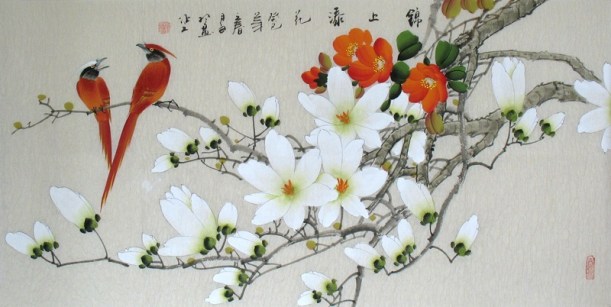
Fine-art-Birds-Flowers-Chinese-Ink-Brush-Painting


Leave a comment

Death (excerpt from the Lenny novella December 2013)

When did death enter Lenny’s life? When did she slide from the domain of fruit trees and storytelling into the sphere of silence? Did it happen all at once, the night of the killings? Or did death enter stealthily, sliding like a serpent from some moss-covered well, grey and white tessellations camouflaged against the smooth pebbles of the formal rock garden?

Lenny had known death. She’d loitered by death’s door, then crept forward quietly and sat by its bedside. It looked out at her through her grandfather’s eyes, and it fixed her in its gaze. She recognized death for what it was: finality. Death, somehow, misidentified Lenny.

“Edie,” said Death, speaking through her grandfather’s thin, scaly lips.

“I’m here,” she replied, taking Death’s hand. Her grandfather’s fingers were mottled flesh and bone.

“Edie,” the ventriloquist voice of death repeated. “You’re here.”

“Of course I’m here,” said Lenny, holding Death’s gaze, holding her grandfather’s fingers. “Where else would I be?”

“I thought you were gone and now you’re here. I still have you.” Death smiled at Lenny.

“I’m always yours,” said Lenny, and now her voice was not her own. “I’m always here.”

The body on the bed was long and lean. If it raised itself up, it could run marathons.

“You’ll never escape me,” it whispered.

“I’ll come to meet you,” Lenny said. Silence smothered the room.

Silence filled the space and squeezed out the air. Lenny couldn’t speak. There was nothing she could say.

“I met you under a plum tree,” the living corpse said suddenly. “You were maybe thirteen. You look just the same.”

The death’s head turned towards her. Its face flushed pink and her grandfather’s eyes animated its eye sockets.

“You are unchanged, Edie,” her grandfather said. “You will always live.”

“Tell me the story, grandfather,” Lenny pleaded. Time stretched forever on that bed but now she felt urgency. Her grandfather was with her.

“You were just thirteen,” he smiled. His tongue moistened his lips. It was not quite blue.

“You stood beneath the plum tree and the petals showered down. You were laughing. You were beautiful and I knew you were the one. The one who would live. The one who would live always.”

“What was I doing, under the plum tree?” Lenny asked.

“Doing? You were being. You were being the eternal one. The one who cannot die.”

“But grandfather,” she said. “I know I must die. I’ve seen it. I’ve dreamed. We will all die. Buildings will burn and my family will be torched. There was blood. Blood everywhere.”

“Petals were falling. Stars burned in the sky.” Her grandfather’s words were suspended in air. His mouth hung open. Lenny was afraid the silence would return.

“You were standing in the moonlight. You shook that tree and its blossoms fell. You laughed at the sky and then you saw me. You put your fingers to your lips and told me ‘Shhh. Don’t tell.’”

“I said that?” Lenny laughed. “A storyteller telling a storyteller to hush? What was I thinking?”

“I have no idea,” her grandfather smiled. “I never understood your stories, Edie. But here’s what I think. I think you knew the end was coming. I think you had dreams. You woke up screaming. But I know you always laughed at death.”

Lenny felt abrupt grief. Her voice fell flat. “How can I laugh, when I’m not allowed to speak? How can I live, when the silence rules?”

The bones entwined in her fingers squeezed lightly. The bones were lightly padded and lightly veined. She could feel their faint warmth, feel their faint pulse.

“You will climb to the heights and hide in the depths. You will cloak yourself in silence. You will learn to use the silence to punctuate your tales. You will bury yourself in your heritage and live forever through it. You know who you are.”

“The one who cannot die.” Lenny breathed the words.

“The one who will not die. The one who refuses.”

“How can you know this?” Lenny demanded. “How can I know who I am? Even you don’t know me, grandfather!”

“Of course I know you, Lenny.” It closed its eyes. “You are the one who evades and confronts. The one who lives.”

Lenny stared at the death’s head and knew her grandfather had gone. Where had he gone, her grandfather and Edie? To what night-land of star-lit plum blossom had their spirits flown?

She let go of the bony hand.

“Grandfather,” she said softly. “Can you hear me? Is it silent where you are?

She paused, and listened. She thought she heard voices, soft murmured voices. She thought she heard laughing.

And she knew. She knew who she was.

“I am a story teller,” she said to the silent room. “I am the one who will not die. I am the one who tells.”

*

Here, in this hole in the ground, she lay in damp mud, a fugitive curled up alongside three survivor comrades.

“Chapin,” She said, grabbing Chapin’s arm. “I’ve dreamed. I know what I need to do now. We need to get out of here.”

Chapin, half asleep, nodded.

“We need to get back into the light to tell our stories. Not the mythic ones. The stories about what happened to us, about the killings, and after.”

She pressed her face close to his. “We’ve been in a hole. We’ve evaded and hidden. Now we need to confront.”

Chapin, now awake, rolled towards his rifle and rose to his knees.

The Lenny novella (c.26,737 words) – 2012 and 2018

blossoms 2


1 Comment

Tea (excerpt from the Lenny novella July 2012)

When the war was over the true terror began. It was the time of the Servants. It was hard for those of us who had been child soldiers. The Servants sent us to re-education camps to learn what service means. We learnt the tea ceremony and how to fellate our teachers. We spent dawn hours in the fields and afternoons doing data entry. In the evening we had group sessions to confess our service failures. Then we poured more tea.

I enjoyed the war. I lived in the hills, sometimes with other child soldiers, sometimes alone. When my home was first burned – when my family was burned – I escaped into the forest and lived alone for months. Mostly on raw bats. Bats taste foul but they’re easy to catch. Beetles are OK. You have to find big ones to get any juice, but the crunchy thing satisfies. I dreamt of pumpkin soup.

But I enjoyed it. The war. The way the sky lit up. So frequent yet so unpredictable. I loved those huge chutes of purple and pink. And yellow. And peach. I wanted weapons of my own, but all I had then was a knife. I wanted to find Servants so I could try it out.

Finding Servants is even easier than catching bats. They don’t take a lot care to cover their tracks. They’d say they do. They’d say they wear black and observe vows of silence to be unobtrusive. To be self-effacing. But except during the hours of the Silent Vow they talk all the time. They yell, they shout, they gossip, they grumble. They’re men. They even piss loudly.

That’s how I’d take down my first kills. They were outliers, men who’d left the group to piss or wank or just be alone. Me, I like being alone, but for a Servant it’s a vulnerable place. If you come up with a knife, unobtrusive, you can angle it upwards under their lower ribs and slash the vital organs. Lots of juice there. They generally die silent.

Sometimes they grunt, and once in a while they roar. If they make too much noise other men come running. That’s when it pays to be self-effacing, and it isn’t something I’ve needed to practice. Though as it happens I’ve accumulated experience.

When I was small my sister said I’d be handy in a war zone. And that was before the war. I don’t know if she saw the war coming then – if anyone did – but that’s what she said. It didn’t help her any. I couldn’t help her. When war arrived she died just like the others.

A war arrives like an unwanted guest. You’re going about your business – working or playing, quarrelling or hugging – and suddenly there’s this presence that interrupts everything. Suddenly everything, everyone, is enforced into its servitude.

I served the war for countless months and I mean that. I lost count. I have no idea how long the war went on. It just went on. Raw bats and blood and beetles and knives. Weapons of all kinds and smashed up entrails. Smashed in heads. Shattered hips and crushed legs. Smears of blood with just traces of bodies. It was good up in the hills where it was green and not red, and where the sky lit up like a pageant nightly. Sometimes there were other kids to talk to, and other kids to fight alongside. Sometimes there was food.

In the tea ceremony, we have to pour just so. The tea must reach a certain depth of colour – not lighter, not darker. We use a certain quantity of tea powder and whisk just so. The texture must be entirely light. We pour precisely to a certain level. We serve with a smile.

I don’t know what end purpose we serve here for. When we reach a certain level we are disappeared. The Servants tell us if we fulfil our potential we will be permitted into their community to represent redemption and model service values. I think they kill us.

The thing is, the Servants have always killed us, and it’s not like they’re dependent on us to serve them tea. They could do their own tea if the tea was what mattered. What matters is the service, which is what they’ve always been about. Once we erase ourselves and are effaced into pure service they’ve made their point; they might as well kill us. Or not. We’ve ceased to exist at that point. But they like to kill, so I think that’s how it ends.

But then again, I like to kill too, and I know who I am. I am a soldier. The more I meditate on serving the more I want to serve, just not quite the way the Servants have in mind. So maybe it’s not over. Did I say the war was over?

*

The tea ceremony? I could perform the tea ceremony with my eyes put out. Maybe some day I will.

These are the elements for the tea ceremony: tea, a small knife, a small mortar and pestle, a tea bowl, a bowl stand, tea cups, a whisk, a low table, a kettle, a kettle stand, a stove (with charcoal), a trainee, a Servant (or several). The teacake is pre-prepared. It’s imported from somewhere, I don’t know where. I believe it grows wild on forested cliffs. It’s white tea, rare and precious. Only the new shoots are picked, when they’re whitish, almost translucent. The shoots are picked at dawn, plump with dew. I’m told they must be picked by long fingernails; finger pads would bruise them.

Who told me this? A girl in the camp. She was a bit older than I am. I only talked with her once, after that she disappeared. I would have liked to ask her more.

The tea leaves are steamed, then crushed, then shaped by a mould into the form of an egg. Why an egg? I don’t know. I think it’s just aesthetically pleasing. Then the tea-egg is dried. It’s wrapped in a very fine tissue, each tea-egg stored in its individual container. The containers are carved from fragrant wood but unembellished. The tea-egg and the containers are smooth.

When I am called to perform the tea ceremony I am required to be washed first. I report to the cleansing studio. In the cleansing studio I am entirely passive: everything is done on my behalf. I am stripped of clothing and my intimate parts are scrubbed using sponges soaked in tepid water. By “my intimate parts”, I mean everywhere there is a hinge joint: between and under my toes, around my ankles, behind my knees, in my groin and where thigh meets hip, under my arms, under my chin, in my elbows, around my wrists, between and around my fingers. Also anywhere there are flesh flaps: my genitals, around my lips, my nostrils, my earlobes, around the top cartilage of my ears, my eyelids.

My scalp is washed. If hair has sprouted, it’s shaved again. It’s important that no blood be spilt so they’re careful not to cut me. The women who prepare me are expert. They do this fast and silently, never making eye contact. When they’re done they step me into a simple undergarment and wrap a large shawl around me. The shawl is fine cotton and feels not unpleasant. The women tuck and fold so the shawl covers me entirely. There’s no risk of it coming undone. I can move my arms and my torso without fearing cloth will fall into the tea bowl.

When I am clad the women paint a single spot on my face, a red dot just below my lower lip. I don’t know what it symbolises but I’m guessing it means something.

The oldest of the women then presents me with a tea-egg container. I am escorted out of the cleansing studio and guided to the tea house. As if I don’t know where it’s located. Tea is only ever served in the tea house. Everything is already set up there. The Servants are waiting.

So when I enter the tea house I see the Servants, sitting cross-legged on cushions alongside a low table. The table is plain and utterly smooth. The Servants wear black, as they always do. For the tea ceremony they wear their indoor robes. The fabrics are fine textured and deepest dark black, but devoid of ornamentation. The Servants’ Silent Vow applies during the tea ceremony, so they do not speak. I keep my eyes down and kneel before the table with the tea-egg container held in front in both hands. I place the tea-egg container on the table, pause, than prostrate myself, forehead to floor. Then I sit back on my heels and pause again.

I open the tea-egg container and lift out the tea-egg in its tissue wrapping. Very gently, I unfold the wrapping so the egg is exposed in my hands. I take the small knife from the table and here I always falter. I am expert with a knife. I can kill with a knife. If I smashed it into an eyeball, or up under a jaw, through the soft part, I could kill at least one Servant. Or through the base of the throat, I’m spoiled for choice. I always look too long at the knife. Then I take it – it’s very small – and ever so carefully shave a tiny piece of tea from the tea-egg. I do this as carefully, as expertly, as the women shaving my body.

Because I shave the tea-egg so carefully the fragment I shave does not break up. I place it in the pestle and crush it with the mortar. I grind for just a moment or two and it becomes fine powder. A kettle has been brewing on the small stove to the side of the room, which is fuelled by charcoal and stoked by the women before I arrived. The kettle is a metal ewer worked in a cylindrical shape – tall, flaring out from a flat small base then narrowing to a small, mouth-like opening. Ovoid,like an elongated egg. The water is boiling now. The water is pure. It’s been sourced from a stream or lake, or so I am told. The higher in the hills the better. I could take the boiling water and fling it in a Servant’s face. There isn’t a large volume of water, just enough for a few tea cups, but hot water stings and I could use that moment to knife a Servant or simply run.

I don’t do that today. Instead I use a section of shawl to wrap my hand and lift the hot kettle from the stove. I pour a small amount into the tea bowl then place the metal ewer back on the stove. Very carefully, I smooth the fine tea powder into the tea bowl with its shallow portion of hot water. This creates a paste. Then I retrieve the kettle with my left hand, wrapped in its shawl, and pick up the wooden whisk with my right hand. I pour and whisk simultaneously, ensuring the paste is diluted only gradually, so that it retains a milky white colour. I rotate the kettle as I pour. As I whisk, using a circular motion, a light head of foam develops. This is known as the Milky Way or Star Flight. It is very important that the Milky Way be frothy yet quite firm, so that it remains in place even as I pour the tea into cups.

The utensils matter. The tea bowl must be thick ceramic, pale duck egg blue. It must be deep, to get a good head of foam, and wide so I can whisk without spillage. The upper lip opens outwards, the texture is entirely smooth. The tea cups are the same duck egg blue, the same smoothness, but thin to the point that to pick them up by hand appears unseemly, even brutal. They look fragile. But so far I have never seen one break, so there must be something in the way they are fired that results in unexpected strength.

I don’t touch them myself. They are arranged on the table and my task is to pour tea. I place the kettle in the kettle stand and the tea bowl in the bowl stand. I bow lightly towards the Servant furthest from me. I say

“May you live in peace.

May you live in harmony.

May the universe shape itself for your comfort.

This is what it is to serve.

You do me honour.”

When the words are said I pour tea for that Servant. He then reaches out and takes his tea cup. The tea should look like cloud against a pale blue sky. Then I turn to the next furthest Servant from me, bow, say the words and pour his tea. Then the next, till however many Servants are present are served.

When the Servants have been served tea they drink in silence. They drink slowly, as tea cannot be rushed. During this time I kneel with my head bent. I do not move until I hear knuckles rapped on the table. This signals that the Servants have completed drinking tea. Now it is time for me to sing. It is always the same song:

“For as long as worlds suffer

I will serve.
For as long as chaos threatens

I will serve.

For as long as darkness rends daylight

I will serve.

For as long as time continues and change reigns

I live only to serve.

O teach me to serve.

Let me honour you with service.”

Then the Servant closest to me lifts his tunic and I am required to kneel over his crotch. I am required to serve. I serve each of the Servants in turn, in silence. When each Servant has been served, the final Servant, the one furthest from where I started, raps the table to signal me to leave.

I return unescorted to the cleansing studio where the women await me. The roster of women changes from visit to visit but the women who prepare me are always the same team who debrief me afterwards. First they use a sponge to wipe off the red dot beneath my lower lip, assuming it’s survived. They wipe my lower lip regardless. Then they unrobe me. Naked, I kneel then prostrate myself. Three times I say “I have served. I have served. I have served.” Then I extend myself fully like a snake, belly to ground, face to ground, and I say “I live to serve.” The women pick me up by reaching under my armpits and hauling me to my feet. They hand me back my regular coarse clothes and turn their backs on me. I walk to the door and exit, returning to the afternoon’s data entry, if this had been an afternoon session, or retiring to barracks if an evening session.

Generally I do two sessions a day. Some of us are seldom called but I have much to learn about service. Since I am a slow learner I’m not afraid I’ll be disappeared soon, but eventually I’ll be deemed proficient in the tea ceremony and then my ultimate self-effacement will be imminent. I am planning. I pride myself on being canny at planning, even if my service failures are gross, so with luck I will have a plan that works before I graduate as a tea ceremony adept.

*

I don’t know what you look like but I know one day we’ll meet. There will be an investigator and there will be a witness. I will be that witness. You’ll ask me about the Servants, and I’ll tell you there’s a lot I don’t understand, but this is what I know:

My family were at home watching TV when a newscast came on to say the Ruler for Life had been in a military plane which exploded over the hills. The Storytellers live separate from other Divisions, in villages clustered in the foothills. Somewhere mid-air between take-off from the airport outside the city and the hilltops near our home, the Ruler for Life had been assassinated.

That’s when war broke out. A lot of us didn’t know how to respond to the newscast. We stayed by our TVs and radios to listen for updates. We logged on to the internet. Within hours we were dragged from our homes and slaughtered, our houses set ablaze. The roads were cordoned off and anyone caught trying to escape was killed. I was lucky. I wasn’t caught.

This is when the Servants came into their own. The Servants started as the Ruler for Life’s bodyguards. After the Ruler for Life was killed, their numbers swelled. The Servants became those who serve the memory of the ruler. The killing was an unspeakable act, so the Servants take a vow of silence. They don’t speak between nightfall and breakfast, nor for an hour either side of meals, and they don’t speak during the tea ceremony. They are required to take part in a tea ceremony daily. The Servants take a celibacy vow. That’s OK. What they do in the tea ceremony isn’t sex. The tea ceremony is about service. Anyone can tell you that.

Service is the Servants’ highest value. Art is ornamentation, is embellishment, elaboration, lying. Art is self assertion. To be a Servant is the opposite of being a Story Teller. The mission of the Servants is to stamp out Story Telling.

That is why I am in a re-education camp. I am being trained in service. I might not like the means by which I am being retrained, the medium by which my voice is smothered, but my likes and dislikes are irrelevant. I am irrelevant. That is why once I fully understand, I will be killed.

My mission is to find you, the investigator, and tell my stories before I am killed.

The Lenny novella (c.26,737 words) – 2012 and 2018

tea bowl


Leave a comment

Roadtrain (1986)

Hugh is getting tired. The more tired he gets, the faster he drives. His eyes are glazed; he should be wearing glasses, but he always manages to leave them behind. Constant small losses; Hugh isn’t thinking about it.

Hugh, in all truth, is trying hard not to think at all. The highway is hypnotic – not winding (no deviation), but occasionally undulating, up and down. Endless white dots are an arrow down the centre, an imperative leading straight to the horizon. Hugh feels as if the white dots power this road. The van is on a conveyor-belt; the white links are the chain on which the mechanism turns. The van rolls forward, propelled by white lines, and to Hugh it seems that speed and destination have been pre-set. A process is in train, and no choice remains but to keep the van on course.

“Where are we heading?” asks Liam, from the back. Part-Irish, part-Aboriginal, Liam is low-voiced and sleepy-eyed. He trusts Hugh.

Hugh does look away from the road. “Wherever the white lines take us”, he says, and Liam, who is used to Hugh’s deadpan humour, nods.

“You’re not still thinking of Jim and Derry?”

Hugh thinks too much. He loves Liam for his intuition; Liam can always tell what’s on Hugh’s mind.

“Naah”, Hugh mumbles, after a pause. He knows he should throw out a throwaway line. Failing anything suitably ironic, he bites his lower lip. Liam leans forward; all he can see of Hugh’s face from behind is the harshness of the ridges marking brow, eye, cheekbone and jaw. Hugh is craggy, closed and worn – sensitive to too-close scrutiny. Right now he feels alone. He can tolerate Liam, but Hugh’s glad the rest of the band is asleep.

The van crests a slight rise. Hugh feels completely disconnected. He imagines he is dreaming, sitting in the care of a long rollercoaster, staring at ground far below. In the dream his hands are off the wheel. He’s waving at the ground, and the expression on his face is amazed.

Over the rise, on the upwards side of an oncoming hill, a roadtrain is ditched. All down both lanes of the bitumen behind it are black and grey skidmarks, coiled tight, doubling back almost over each other. Gouges savage the sides of the road; gravel has thrown up banks, furrowed troughs. As Hugh drives by he stares at the truckie, squatting beside his broken rear axel. The truckie looks scared. Half-blocking the road on the far side of the truck is a long, dented wheatbin. All down the road, twice the roadtrain’s length, are its entrails – spilt wheat, training blood betraying a wound.

Hugh can’t take his eyes off that truck, that wheat, that man. In the late afternoon glare he sees the wheat’s brightness not as gold or blood-red but as flame. He sees Derry and Jim, trapped in the cabin of the roadcrew’s truck: Derry unconscious, barely breathing, Jim screaming, desperately trying to bash through fire. The truck, glowing molten, roars in the heat. It lies on its side, by the side of a highway. Jim can’t get out, and even in his dreams, Hugh can’t reach him. They’ve been trapped there in Hugh’s mind a year now.

“Here”, says Liam, gently. “I’ll drive…”roadtrain2_96694170


Leave a comment

A Story (1984)

“Tell me a story, Bev.”

Bev looked across her bed to Deb’s, and saw her sister as a mountain cat crouched low along a tree limb, eyes burnished by the dark.

“I can’t.”

“Go on, Bev. Do it. Tell me a story.”

No, thought Bev, and rolled over, flat on her back. She placed her hands under the bulb of her skull, and relished the ‘V’ between nape and elbows. Toes pointed, she stretched her feel away from her head. Her body worked – everything in order.

“No”, she said. “I think it’s childish. I can’t just make up nonsense any old time, anyway. It’s bad enough having to share a bedroom, without having to tell you bed-time stories every night. Go to sleep.”

“I can’t”, said her sister. “I feel bad.”

Bev thought this over. It felt bad just to think about Deb’s problem, let alone to have it. She softened. She sat up.

“Are you going to tell Mum?”

“No”, said Deb.

“You could, you know.”

“Yeah.” Deb sighed. “Sure I could tell her. She’d cry and I’d cry and we’d both feel lousy. It wouldn’t change anything. What could she do about it? Why bother hurting her?”

“I guess so”, said Bev, humbled. Somehow it seemed very brave and adult for Deb to refuse to inflict pain.

“She’s got enough to worry about, anyway”, Deb continued, suddenly less generous – even oddly resentful. “It’s hard enough putting us two through school and having to work at that horrible job, without Dad going crazy as well. He really picks his times!”

That’s not fair, though Bev. It’s not as if he had any choice – any more than you did.

“What will they do to him this time?” she said, instead.

“God, I don’t know! Why should we bother? It’s not as if he’s bothered with us for years!” Deb snorted harshly. Then, as if chastened, she added meekly “Put him in a funny farm at last, I guess. Let him draw it out of his system.”

Bev nodded uncertainly. Their father had been a commercial artist, employed to draw fashion designs in dress-pattern catalogues. Always highly stylised, the limbs and faces on the mannequins he sketched had grown longer and more gaunt with every season; their colouring had paled, grown ashen, turned blue. Last catalogue, his folio figures were grotesque: emaciated corpses, stretched as if broken on a rack. Their jaws lolled. Their creator was fired.

“Do you think he’s really crazy, Deb?”

“Yup!” Deb chewed the syllable, then spat it out again. “Yup. I sure do.”

Bev sat back in her blankets and pondered. “If we tell Mum she might tell Dad.”

“No way!” A flat, emphatic statement. “And we’re not going to tell Mum anyway, are we?”

“No”, said Bev, brave and obedient.


Last summer Bev and Deb had squandered at the beach. Every weekend, and all the holidays. They even wagged a day from school. With a group of friends they’d caught the train to Geelong, and from there they’d hitchhiked down the coast. Bev had turned fourteen that week. It was the first summer she’d looked good in a bikini, and she’d sauntered around the sands all day, trying out effective hip and leg angles as she walked, as she swam, as she shook out her beach towel.

On the train coming home, an inspector had asked to see their tickets. First the others, then Deb and Bev.

“Names”, he demanded, in a disinterested tone, and not knowing any better, they’d given them.

“Same surname, eh? Sisters?” Not knowing better, the two had nodded.

“How old?” barked the ticket inspector. Deb – who was travelling on a half-fare ticket – dumped fifteen months and answered “Fourteen”.

“You?” the inspector asked Bev, and she – more tall, more solid than her sister – had whispered “Fourteen” too.

“Really?” the ticket inspector sneered. “You can’t both be fourteen, sisters!”

A moment’s awkward silence. Then Bev, the unembarrassed liar, said quickly “I’m adopted”. A self-serving faker, only part way developed.

Bev was growing up, and she learned fast. Deb could trust Bev, and she did.

“I don’t want a baby”, Deb confided.

“You’re not going to have one”, Bev reassured her, adding, confused, “I am mean, you may be going to have one at the moment, but it’s not going to really happen, is it?”

“No”, said Deb, shaking her head slowly. Both lay quiet in the darkened bedroom. Deb, sighing, added the unsaid.

“Rob wants to marry me, Bev. Me, at sixteen, married with a baby! I couldn’t bera it!”

Bev couldn’t bear the thought of it either. Deb didn’t trust Rob, and she didn’t love him. Not like she loved her sister.

“He’s getting really heavy ‘cos I won’t, Bev. He shouts things at me when he sees me at the pub. I can’t hang out with the beach crowd anymore. He’s told them all sorts of lies about me.”

Don’t cry, blossom, Bev consoled mentally. “I don’t like any of them anyway”, she pouted.

“No”, murmured Deb. “Maybe not. But I did.”

“There are lots of better people in the world than that, Deb. There are better parties than the ones they give, and better pubs to go to.”

“Yeah”, Deb agreed. “And there’s more to life than people and parties and pubs and things. I can do better than that.”

Bev remembered the beach last summer. After the pub one night, Rob had thrown a party at his parents’ beach-house. All the local kids had turned up there too. She’d got really drunk on bacardis and coke, and Jamie took her for a ride in his new van. He’d driven up to the look-out on the sand-dunes, and they’d just sat there, saying nothing. She’d had the feeling she should do the talking, and that she should know what to say. But she didn’t, and before long Jamie sighed, and drove her back.

At the house, she felt ill. She wanted to go to bed. Rob had told her she could have the room upstairs, but when she turned the lights on, someone else had already claimed the bed.

“This is my bed”, insisted Bev stoutly, yanking the coverlet towards her. The stranger took no notice.

“All right”, said Bev. “If I can’t get you to move, I’ll just have to get in anyway.”

So she did, and that was that.

“Does it feel good?” the stranger asked.

“Yes”, Bev lied. She would not breathe another word, not then or later. She nearly did, at one point – when he moved on top of her, he hurt so much, and for so long, she was just about to cry out “STOP! Forget it. Pleeease stop!” But then it hurt less, and she was so relieved she really didn’t care that less was still a lot.

She felt she was brave, and adult – like Deb about her baby, or (she imagined) like women giving birth. She felt suitably initiated, as if at last let in on a fundamental secret, and the secret (she believed) was that no matter what they tell you, it’s horrible. It hurts. Reality, she now knew, hurts.

Deb’s baby would soon be a reality, but Bev felt confident that here, reality could be thwarted. Out-manoeuvred. It wasn’t going to happen, was it? Not if Bev or Deb could prevent it. They lay there in darkness, counter-plotting.

On the morning, the two girls wagged school and instead caught a tram to the clinic. They walked in past protesters bearing placards, picketing outside. They walked square-shouldered in private school uniforms. Bev wanted to follow Deb and the woman doctor into the surgery, but the doctor told her to stay in the waiting-room, and so she did.

The uniform made her self-conscious. She placed her feet primly together, and was surprised and impressed by how long her legs had grown, shaven and smoothly brown. She looked across at the wall-mirror: all her limbs were long, straight and gleaming, like her hair. She picked up a magazine and leafed through it. She looked at least as enticing as most of these models, Bev realised, with a thrill tempered by alarm. She’d never before thought of herself as ‘enticing’. ‘Appetising’. ‘Desirable’. Foreign words. Yet she was all this; she could con with the best of them. The thought gave her pleasure, yet it also disturbed her. She put it aside, intending to take it up again later.

Deb and Bev caught a train home from the clinic. Neither had anything much to say.

“Are you okay?” asked Bev, and Deb insisted she was fine. Bev, content to believe her, was massively relieved.

“Here, I’ll tell you a story on the train,” she beamed at her sister, who smiled back wanly. To the station attendant, she held out a handful of silver and said “Two adults, thanks”.

Schoolgirl

Me. (This story is not about me.)


2 Comments

Mickey Mouse and Donald Duck. By Daffy Duck. (10 June 2014)

Image

Last week I was listening to a radio program where the guests being interviewed had both recently published memoirs. One person, radio broadcaster and Australian arts identity Sian Prior, had published a memoir exploring the issue of shyness through her personal experience and research. Her book is called Shy. The other, Bev Brock, had written what she sees as essentially a self-help book, titled Life to the Limit.

Besides being intelligent, adult women who are published authors, these two have this in common: they are former partners of famous men acclaimed as Australian cultural icons. Sian Prior was for nine years partner to Paul Kelly, the much-loved Melbourne-based singer-songwriter. Bev Brock was the long-time partner of motor racing hero Peter Brock; Bev adopted his surname and the couple had three children.

I knew Paul Kelly in the ‘80s. Not well, but enough. He was the brother-in-law – and for a time, the housemate – of a friend and neighbour. I’d interviewed him in my capacity as a rock music journalist and I’d reviewed his records. In the early ‘80s I was a regular at his band’s gigs, where I loved to dance and sometimes hang out with the band afterwards.

I never met Peter Brock but I did know one of his girlfriends. What she had to say about Peter confirmed the sour opinion I’d had of him since the mid-70s, when his second wife claimed he’d battered her from the outset of their marriage, leading to her suicide attempt.

The interviewer, ABC Radio’s Jon Faine, asked both authors challenging questions about, essentially, the ethics of writing about famous others. He grilled Sian Prior on why in her memoir she chose to give her ex a pseudonym rather than using his real name. They’re both public figures, most Australian readers will know who she means, so why not name him?

With a degree of graciousness I have to admire, Sian pointed out she gave pseudonyms to all her friends mentioned in the book. She pointed out that her book, Shy, is about shyness. If she were to use Paul Kelly’s name, people would assume it was primarily a memoir about their relationship, which it is not.

Bev Brock explained her book explored emotional issues and challenges and needed to be truthful. The truth was, Peter was a shit (I paraphrase).

I was surprised by how tough the questioning was, especially the questions put to Sian. People who disclose unpleasant aspects of our idols are often censured. But the reality is, we, the public – listeners, viewers or readers – experience a frisson when the shadow side is revealed. Hypocritically, we might wag the finger of reproof. But we listen up.

I was even more surprised when I went online at my local library’s website to request a copy of Sian’s book, Shy. It was released two weeks ago, and 22 people had logged a borrow request and were on the waiting list. I live in a small town. My small town has the nickname “Sleepy Hollow”. It’s possible 23 of us jumped at the chance to read a book about shyness immediately on its release, but I’m guessing we’re mostly motivated by prurience: a chance to peek inside Paul Kelly’s private life.

As I was listening to Sian and Bev, the program host interrupted the interview to report the death of another Australian icon, Doc Neeson, frontman of the band The Angels. I knew Paul Kelly only in passing, and Peter Brock only through hearsay, but Doc I’d known as a friend. I was prompted by news of Doc’s death to start writing a series of short memoir pieces I’d been considering for some time; over this past week I’ve written five short tributes to five people who I cared about deeply and who mattered in my life.

I think of these linked pieces as my Five Dead Rock Stars series. That’s sounds callous, and doubtless is. It’s a nod to my friend Vince Lovegrove, the fifth of my Dead Rock Stars, who planned to call his memoirs Twelve Angry Women.

Engaging with the writing, inevitably the ethics of writing about people who are famous arose. Sian and Bev wrote about intimates; I was writing about famous people I thought of as friends but whom others might say were acquaintances – certainly, there are many people better placed to write more insightful accounts of my subjects’ lives, having known them longer or more fully. My pieces were not biographical; they were personal reminiscences, and fragmentary.

There was a lot I left out. It wasn’t needed, or it didn’t fit. Or it was impertinent. Or best forgotten. Or I am not ready to write about it yet.

In writing about our experiences, we process them anew, and sometimes gain clarity. I read – then re-read – a paragraph I wrote about myself at 21, accepting a handful of white powder backstage, Angel Dust or PCP. I can’t remember much of the events of that night, but I remember trying to walk home, through suburban Melbourne, from the bayside red-light district St Kilda. I could have died that night. I could have died during that horrible aftermath of strangulated breathing and turning blue. I could have died – as another young female rock writer did, in Kings Cross in the ‘90s – if a rapist-killer had spotted me vulnerable in the night.

If I had died, the futures of the bands who played at that venue that night might have been very different.

Reading that paragraph, I remembered another occasion, in 1981. I was visiting a musician friend at the house he shared with his girlfriend and a couple of Class-A drug dealers. I wasn’t taking drugs; I did drugs on four occasions across a 12 year period and that night was not one of those four nights. Someone OD’d. I remember one of the other people present, not the musician, urging the others to dump the unconscious body in an alley. Whatever happened, it could not be linked to them.

Happily, I can report this suggestion was rejected. The suspected OD case was revived and life when on.

For obvious reasons, I’m not willing to name names when writing about this incident. But as I read my own account of the night I almost OD’d, the chilling realisation hit me that the people backstage that night might readily have dumped my body in an alley. I was writing about the dread I had at that time, the dread that people I thought were my friends, were not. As I read back what I’d written, I knew, and I knew that I knew then: Of course these people were not your friends – how could your “friends” have let you stagger off into the night, alone?

How could I have continued in contact with those people, knowing I knew? Knowing they didn’t care if I lived or died, as long as I didn’t die at their gig, backstage? Of course I must forget.

As I tossed and turned, literally, unable to sleep, remembering what I’d forgotten, I started getting feedback on the memoir blogs I’d posted. I got no comments whatsoever, from any one from that period, on the first three blogs. But the fourth one, the one which recounted the incident with the white dust, that one drew comments from two old friends.

They were angry comments.

I’d written about my reaction on hearing of the blog subject’s death: since we’re not naming names, let’s call him Mickey Mouse. I wrote rather histrionically – “self-dramatisation”, as one commenter opined – about my shock at logging onto a news site and seeing a headline reporting his death. Except the headline didn’t name him, not by his real name nor as Mickey Mouse. The headline referred to him as the drummer in x band (not x, let’s call them Bedrock, in honour of the Flintstones). There had been several Bedrock drummers, so for a moment I had the wild, savage hope it was not my friend who’d died, that it might be another. Let’s call that other Donald Duck. In my blog I used Donald Duck’s real name.

I am told the use of his real name was callous and indefensible. I was told I suffered moral blindness, a failure to imagine the pain his family and friends would suffer, when, inevitably, they read my blog.

I don’t see it, myself. For starters, who is actually reading my blog? I can count the comments on the fingers of one hand. More to the point, if a septuagenarian veteran muso is traumatised reading that, given the choice between his death and her friend’s, some stranger would rather he had died, just hand me a dose of white powder right now. I don’t know Donald Duck, but I strongly suspect he’s old enough and ornery enough to cope.

In writerly terms, using the name was a harsh counter-note to the sentimentalism immediately preceding and following. It’s discordant. It’s nasty. And I never said I was nice.

I have however removed the name. Not because I think the use of the name has magical properties that could harm the person named. Not because my friends called me names. I removed it because the piece was intended as a tribute to someone I thought I loved, and I did not want what I consider a nonsense issue to detract from that.

I removed it with regret. I think the paragraph, and the piece, is weakened by not having that moment of authentic nastiness.

I remain perplexed that people who have been important to me could read all that I’ve written this past week, without comment, read the incident where a young girl is abandoned while seriously drug-impaired (though they might discount this as self-dramatisation), yet a few paragraphs later hurl into moral paroxysm over two words: the real name of Donald Duck.

But I guess there are multiple categories of people, quite apart from cartoon characters. There are famous people, lovers, acquaintances, friends, and “friends”.


Leave a comment

Vince Lovegrove. Legend. (8 June 2014)

Note 14 December 2016: The ‘Five Dead Rock Star’ pieces were written when I was depressed. I’ve left them to stand in their original versions, but they could be written very differently.

golden-star

Vince Lovegrove told me once that he planned to write his memoirs and title them Twelve Angry Women. Only twelve? I asked.

Vince angered a lot of people in his life. He was confrontational. Combative. Phenomenally passionate, with an immense capacity both for love and hate. Vince valued loyalty and yet too many of his relationships – sexual or otherwise – ended badly. He believed in living life on the edge; life without adrenalin was no life at all.

Vince is remembered, rightly, for his massive contributions in two domains: he was a champion of Oz Rock, the Australian pub rock music scene and its bands who went on to success internationally; and he raised awareness of AIDS, becoming a public symbol of tragedy and hope. I remember him as a hero who first appeared in my life when I was age eight, and who, of all the people I knew in my teens and 20s, I most trusted, could say with certainty was solidly my friend.

I turned eight in 1969, when Vince was singing in a Perth-based pop group called the Valentines, sharing vocals with Bon Scott, future lead singer of AC/DC. I met Vince the summer of 1970, not long after he moved to Adelaide, when he was dating the woman who became his first wife: Helen Corkhill.

It’s strange, writing memoir pieces. Every so often, just as a life threatens to flatten into a chronicle of years and events, a name or an incident will come alive as I type, spring up with vitality, and make me pause, and smile. The thought ‘Helen Corkhill’ does that for me. Helen was glorious. She was a drop-dead gorgeous, strong Aussie sheila who hailed from Broken Hill, the mining town BHP built on flat red desert in the Outback, in far west New South Wales. She’d come to Adelaide to train as a nurse, forming a tight clique with a bunch of other gorgeous, glorious girls: among them, Gill Harrington and Gill’s Adelaide cousins, Mary and Ully Christie.

Mary had been one of my mother’s students. She baby-sat me and my sister. She became a close family friend. My parents liked to party, and Mary introduced into our lives a bunch of party people, among them Helen and Vince.

I remember Vince at a party, telling me earnestly as long-haired hipsters milled around, “You are way too clever for a child of eight. You are too clever by half. You are scary clever.”

In 1973 my family moved to Melbourne. Vince and Helen, with their baby, Holly, moved to Melbourne in 1978. Vince had been working as a rock journalist and producing and presenting music television and radio shows, including, that year, Australian Music to the World. In Melbourne, he produced the top-rating variety show, The Don Lane Show, and was youth issues reporter for A Current Affair.

But his marriage to Helen didn’t survive. I left home and moved to Sydney in late 1979, and early in 1980 (a year earlier than Vince’s Wikipedia entry states), Vince moved to Sydney too. Vince and I shared an overnight car ride between Melbourne and Sydney. We dissected the hit singles on the car radio. I liked Linda Ronstadt’s single from Mad Love, How do I make you? I loved Tom Petty’s Refugee. We fell silent as Martha Davis from The Motels sang their hit Total Control. We talked and talked and laughed a lot and bonded.

I hasten to point out the timing was coincidental. It was coincidence, again, that I rented a small flat in Paddington close to the Paddington townhouse Vince rented with his girlfriend Daina. But that did prove handy. I was often at Vince and Daina’s place, for company and morale-boosting, and I baby-sat Holly when a babysitter was needed.

In Sydney, Vince hung out with his rock scene mates who included Cold Chisel lead singer Jim Barnes and the other Chisel band members. In the early ’70s Vince and Helen ran a booking agency in Adelaide called Jovan, which managed AC/DC at that band’s inception and also managed the embryonic Chisel, at that time – in the words of rock journalist Anthony O’Grady – a “hard rock jukebox”. By early 1980, propelled by original material by keyboards player Don Walker, Chisel had two successful albums to their credit and were preparing to record the classic Oz Rock album, East.

Again by coincidence, Cold Chisel were among the few people I knew in Sydney who I had met prior to relocating. Vince tutored me in the back-stories – personalities and music industry politics – of the people I met as I started out as a rock writer. He helped me navigate some of the risks, steering me well clear of drug use and watching out for me as I fielded predators. Because Vince had my back, I felt able to stand up to bullying. Because Vince had my back, I was targeted less viciously, perhaps, than I might have been otherwise.

I do remember standing in the kitchen at Vince and Daina’s place with a group of people, drinking, while a record producer on the ascendant sneered at how I was dressed.

I threw it back at him. “My skirt is $18 from Target. My shoes are $10. The shirt is from K-Mart. The earrings are $300 from Manila.”

Vince thought that was hilarious.

At about that time Bon Scott died. Vince loved Bon. After the Valentines, they were bandmates again in Adelaide, in the Mount Lofty Rangers, then there was the Jovan-AC/DC relationship. I remember the night we heard Bon was dead. It hit Vince hard.

When Vince’s relationship with Daina ended, he moved to a dilapidated top floor flat on or just off Womerah Avenue, near Kings Cross. He was rock music columnist for the tabloid newspaper, The Sun. I was there with Vince one day when I heard the wooden stairs that led up to his flat creaking as a visitor climbed up to join us. I heard the visitor sing, soft and low, no hurry, her voice languid molasses. I was startled by that voice, so distinctive. I stared at Vince. He was ready: he’d anticipated the question.

“That’s my new girl singer,” he said. “Her name is Chrissy Amphlett.”

Chrissy became the lead singer of the band Divinyls, who were managed by Vince in their early years. In her autobiography Pleasure and Pain, Chrissy writes at length about how Vince influenced the Divinyls’ sound and stage act. He believed rock’n’roll should be explosive, should always feel threatening, never safe. He insisted Divinyls gave their guts, every time. Vince’s drive and aggression doubtless took its toll on individual band members. But it got them to America and it bred hits.

In the States, Divinyls were signed to Chrysalis Records. Vince got involved with a Chrysalis publicist. I spent a few months in Los Angeles in 1982 and Vince’s friend, Eliza, was hospitable. She moved to Australia to work for Divinyls with Vince but it didn’t work out, professionally or romantically. She saw herself as a skilled professional who’d been demoted to answering phones. On his home turf, Vince’s macho traits were less attractive. By late 1983, Eliza had a new man, a young New Yorker called Chad or Chip or Chuck, and Vince was increasingly appealing to me to divert them away from him, to keep them occupied socially. I tried. It was complicated by Chad or Chip’s occasional violence. When Cold Chisel split and did a final tour, I was not thrilled at once again being asked to baby-sit, this time for Eliza and Chad/Chip. On New Years’ Eve 1984 I abandoned Eliza at a beachside pub, at a round table of drunken journalists. She never spoke to me again.

I worked for Divinyls with Vince myself, for one day. At the end of that day we tacitly agreed I had no future answering phones.

Vince’s relationship with Eliza overlapped with the early phase of his relationship with his second wife, a thin brunette New Yorker who called herself Suzi Sidewinder: Sidewinder, both for the venomous rattlesnake and for the short range air-to-air missile. Suzi had danced with New York club act Kid Creole and the Coconuts.

Vince was entirely enamoured of Suzi and once she moved to Australia, we stopped being close. I found her abrasive and I thought in her company he was doing too many drugs. I might have been wrong. One time when I was climbing William Street, up towards Kings Cross, I saw them in my favourite pizza shop, waiting to collect their takeaway pizza. I tried to engage in what I considered normal conversation, but what met me was glazed eyes, giggles, and that odd knowing stare that says, “I know what you’re up to. Don’t think for a moment I trust you.”

Next time I saw Vince I remarked on his strange behaviour. He countered that I was the one who’d been strange.

Vince and Suzi had a child, Troy, and married. The bride wore black. Within months, I was hearing gossip. Suzi at a party, asked about her baby, flinging back, “Vince’s baby. Not mine.”

After Troy was born, Suzi had shingles. If you’ve had chicken pox, chances are the virus is lying dormant and may be reactivated as shingles, a painful rash, at a point in your life when your immune system is vulnerable. Usually in old age. It is not usual for a healthy young woman to have shingles. Testing showed Suzi was not a healthy woman. She was diagnosed in 1985 with HIV/AIDS. Further testing showed Troy had HIV/AIDS too.

Vince told me Suzi felt gut-wrenching guilt over Troy’s condition. Her seeming rejection of her baby was the grief of a woman who thinks she’s killed her kid. In 1985, AIDS was thought of as a ‘Gay plague”, confined to male homosexuals. Many people saw it as a consequence of an immoral lifestyle, of promiscuity and, specifically, anal sex. The other high risk group was intravenous drug users. Vince and Suzi rejected any suggestion Suzi injected drugs. As one of the first women diagnosed with AIDS in Australia, Suzi presented a face of AIDS that shocked the heterosexual community: a young mother – a beautiful girl connected to celebrity, her life ahead of her.

Suzi’s life after diagnosis was short and painful. I visited Vince in the large house moneyed friends had rented for them. (Some of their friends, like Jim Barnes, were generous. Others disappeared.) Vince and I talked for a long time. I was hesitant to go upstairs and visit Suzi; Vince told me she did not want strangers to see her as she was.

Suzi died in mid-1987. A documentary, Suzi’s Story, was screened on Network Ten and caused widespread reaction, from concern to consternation. The documentary won awards. At about that time the notorious ‘Grim Reaper’ AIDS awareness advertising campaign ran, delivering the message that anyone was vulnerable. As it happened, during that period I knew the advertising director who created the ‘Grim Reaper’ campaign, through our mutual involvement with a seminar-based, personal effectiveness organisation in Sydney. I knew Vince was flailing, caring for Troy and trying to think through what his own future might hold, so I invited Vince to an information evening held by this organisation to promote an upcoming “transformational” seminar. Vince came simply because I asked. Because we were friends.

Vince was broke and embroiled in legal actions. He was doing his best by Troy and it was killing him. Troy spent countless hours in hospitals, undergoing countless medical tests and procedures. Vince told me Troy would scream when they headed to hospital; what Troy went through looked to Vince like torture. Troy had contracted AIDS in utero and there were few similar cases in Australia. Vince’s baby was effectively a medical guinea-pig.

The public interest in Suzi’s Story meant people recognised Vince in the street. People he didn’t know were constantly coming up to him and sharing their responses, sometimes clumsily. People wrote to him. Some saw him as a hero for his fundraising efforts on behalf of AIDS research and for going public with his family’s tragedy to raise AIDS awareness. Some saw him as a hero for attempting, as a widower, to care for a child born with AIDS. He received marriage proposals by mail.

I asked Vince whether he planned to continue his involvement in AIDS activism after Troy died. Vince was adamant: once Troy died, he wanted nothing to do with it. He wanted his life back. If he couldn’t have back the life he’d had, he wanted a new one. He wanted to go somewhere far away.

Troy lived longer than expected but died in 1993. The Australian Broadcasting Corporation (ABC) screened a documentary called A Kid Called Troy. Vince wrote a book, A kid called Troy: The moving journal of a little boy’s battle for life. Once that was completed, he was a man unanchored. Fortunately, his friends cared.

Jimmy Barnes, who had established a successful solo career after Cold Chisel split, invited Vince to manage a European tour for him. This was generous of Jim but proved confronting for Vince, who told me years later he was shocked, on the tour, by the state his friend “Barnsey” was in. It’s no secret, now, that Jim descended into a hell of drug and alcohol misuse before getting sober in 2001, a sobriety he’s maintained. In the early ‘90s, Vince saw his friend in a state of self-loathing. Vince didn’t want that to be him. He wanted his new life.

So in 1994, Vince moved to London, where he returned to writing about music. I’d moved to London in 1992 but I didn’t learn Vince was living there until 1998, when I saw articles he’d written about Michael Hutchence’s death. Vince was writing an unauthorised biography of the INXS singer, which came out in 1999. We had some long phone conversations, where Vince talked through how he saw Michael’s life and death; we’d both known Michael and this was personal. The Hutchence biography came out in 1999 and resulted in immediate law suits initiated by Michael’s partner Paula Yates. In his book, Vince contended that Paula Yates ensnared Michael by falling pregnant. (I don’t recall this as one of the “Michael life theories” he floated with me. I would have warned him off.) The libel case was settled, with an undisclosed sum paid by the publishers in Sydney and London and by the UK tabloid, The Mail on Sunday, which had serialised extracts.

Beyond discussing Jimmy Barnes and Michael Hutchence, Vince and I talked about his life in London. He was newly single, his third wife having left him the previous year. He joked, “I’m always left with the baby!” Lilli-Rae was maybe three.

This was when I heard about the Twelve Angry Women.

“How come all the women I get involved with turn out to be psychos?” Vince demanded, with what sounded like genuine perplexity.

We discussed meeting up. But we didn’t meet. I’d heard something in our conversations that made me worry Vince might hope we’d get together romantically, which had never happened in the past and was not something I saw in our future. I did not want to turn psycho. For his part, Vince might have heard the same echo down the phone line, and might have drawn the same conclusion. He was 50, fat, bald – no longer the brutally handsome heart-throb.

Vince returned to Australia with Lilli-Rae and settled near idyllic Byron Bay in northern New South Wales. Holly and her son Arlo lived nearby. In 2011, Holly gave birth to Marlon, a second grandson for Vince.

In late March 2012, as I was sitting in an office reception area waiting to negotiate a return to work plan with my employer, following an injury, I flicked through a newspaper and saw a headshot of Vince staring out at me. Vince was dead. His Kombi Van had left the road, rolled and exploded in flames in the small hours of the previous morning. Positive identification was yet to be made.

Vince’s death was reported in the media. His loss did not go unremarked. But somehow, to me, it did not feel enough. Vince was bigger than that. I felt like a bigger noise should be made at his passing, a much louder keening.

So here’s my attempt:

Vince Lovegrove was a legend of Australian rock music. He started as a pop singer, managed bands who remain Oz Rock icons, knew everyone who had any kind of profile in ‘70s or ‘80s Australian rock, had his byline as a rock writer in mass circulation publications, and produced landmark music television shows. In the troughs between successes he always returned to writing about music. When he died, at age 65, he was due to start work in a few days’ time at a small regional newspaper, with a minuscule daily circulation.

Vince could be pugnacious. He laughed like a pirate. He was foolish and wise, all at once.

He was loved.

Vince Lovegrove Elly McDonald

Vince Lovegrove


27 Comments

Someone Famous, With Girl – for Michael Hutchence (5 June 2014)

Michael Hutchence asked unexpected questions. Like, “How do you say, ‘I love you!’ in Mandarin?”

“My” Michael – Michael as I knew him – was not the mythic Michael of the tabloids. “My” Michael was a sweet, rather whimsical boy with cosmos-encompassing curiosity. When I think of Michael, I think of Snufkin, the character in Finnish author Tove Janssen’s Moomintroll books. Snufkin has a round head, shaggy brown hair and big brown eyes, and that’s how “my” Michael looks in memory: a round face on a stalk neck. Snufkin was a wanderer, seeking spring and summer meadows: that was Michael. Snufkin was a provocateur, baiting authority and despising convention. As did Michael.

I first heard INXS at a live gig at Sydney’s Stagedoor Tavern, just after INXS moved from Perth to Sydney and just before the Stagedoor Tavern was closed down. INXS were bottom of a four-band bill. I couldn’t see the stage so I couldn’t see the band (the crowd was packed for the headliners, The Angels), but they sure sounded good. I was writing for a rock magazine called Roadrunner and I marked INXS as a band for me to interview.

The interview took place in February or March 1980, about the time I started writing for RAM (Rock Australia Magazine). I didn’t write the first INXS piece in RAM, but my article ran in Roadrunner, and a few years later I wrote RAM’s first cover story on INXS. Some of the more sensational Michael quotes from that RAM cover story were lifted by Sydney’s tabloid newspaper, The Sun.

In early 1980, INXS were still playing small venues. I interviewed them in a joint off Oxford Street where capacity must have been less than 100. The entire band sat around a table, eager to talk about their music. At that time an interview must have been a novelty. Michael’s curiosity showed up as alertness. He sat with spine long, long neck; not the languid, mannered stance familiar in later years. But whatever the body language, Michael’s physicality always spoke to me of dance. He stood, he sat, he moved like a dancer. On stage, he danced. Michael had vitality and grace.

He also had bad skin. When people started talking about Michael as a sex symbol, I was initially nonplussed. He was a skinny kid with pockmarks. Recently I watched again a music video from 1981, “starring” Michael: Speed Kills, written by Cold Chisel’s Don Walker for the soundtrack to the film Freedom, with Michael on lead vocals. In that clip I see the emergence of the “mythical” Michael – the cool dude with white hot sexuality. I didn’t see it at the time.

At the time, when we sat in that small dark room and talked, Michael was barely through his teens and was dressed like a fan of French new wave cinema, in a Breton fisherman’s long-sleeved t-shirt with horizontal stripes. He told me he was fascinated by post-War bohemianism, especially the literary and artistic bohemianism of the ‘50s and early ‘60s. I thought of Julie Christie, before she became a film star, a boho chick living with actor (and art school grad) Terence Stamp. Michael would have loved Julie Christie.

He talked textiles. Michael’s father Kell had been a textiles trader in Hong Kong. Michael loved colour and texture and trends, so he loved textiles. And he loved Hong Kong. He loved noise and close-pressed flesh and variety and change. Bewilder me, he beseeched. Fascinate me.

Michael could be mischievous, if I may use that word to cover a multitude of, literally, sins. In that first interview, he brought up one of my Roadrunner reviews that he said had made him laugh. It kicked off with some cruel comments about a band who at that time shared the same booking agency as INXS, a brother-sister combo called the Numbers. I liked the Numbers. I just couldn’t resist the impulse to be bitchy about their platinum blonde good looks. Michael had a bit of bitch in him too. Andrew Farriss, the INXS keyboard player and main writer, did not approve. Andrew never took to me, at all.

What sealed it for Andrew was that cover story I wrote in 1984. INXS were touring in support of their album The Swing. I had reviewed their previous album, Shabooh Shoobah, for RAM, and I’d loved it, so RAM’s then-editor Greg Taylor sent me off to Canberra with a specific brief: get an interview with Michael Hutchence.

That may have been the beginning – or an early instance – of that issue that plagues so many successful bands: the focus on the frontman, eclipsing other band members.

As the band and I travelled together to Canberra, I mused on the outfit saxophonist and guitarist Kirk Pengilly’s girlfriend Karen was wearing. It was white and flouncy with pastel trim. To me it looked like a cake decoration, perhaps a wedding cake. In the published article, I reported that reflection. I didn’t know Karen was an aspiring fashion designer, who succeeded in a career as an accessories designer. After publication, I heard Andrew felt my comment was disrespectful.

Michael didn’t have those inhibitions. Michael truly did not have a lot of inhibitions. The Canberra gig was wild; it took months for me to figure out how to remove the Bundaberg rum and coke stain from the drink spilled on my favourite top. It took hours for Michael to come down from his post-performance high, sufficient to consider an interview. By the time I turned the tape recorder on, we were both stripped naked, in our separate beds, in the hotel room we shared that night. For me as a rock writer, it was unprecedented, and frankly unexpected.

That’s when the question was asked: “How do you say ‘I love you!’, in Mandarin?”

Michael was in love. He was dating Michele Bennett, who had studied Mandarin at Melbourne University. Michele was exquisite and Michael was besotted. That did not preclude other flings. But I found it touching, and Michael and I did not fling.

I went round one time to the home Michael and Michele shared with New Zealand singer Jenny Morris, who became an INXS backing singer. The boys were ready to party. The girls were upstairs: Jenny singing, her voice melodic, honeyed and seductive; Michele was tweaking perfection, putting on her makeup.

“This can take hours,” Michael grimaced. He looked and sounded proud.

When INXS were recording their international breakthrough album Kick, I bumped into Michael on Williams Street, the arterial road leading up to Kings Cross. He invited me to hang out with him at the recording studio, Rhinoceros Studios in inner East Sydney, the hippest studios in town. Slack hours in a studio recording an album can hang heavy: an hour of studio downtime lasts longer than an hour of standard time. But I’m not sure that’s the reason Michael invited me. I’m not certain he was enjoying extended downtime with his fellow band members just at that point. They were there, except Andrew, but Michael mostly talked with me.

As I was leaving, I passed Andrew Farriss in the corridor.

“Hi!” I said brightly. “It’s Elly!”

“I know who you are,” growled Andrew, brushing past me.

What did Michael talk about, that day?

He talked about romance. He talked about sex. He was intrigued by the concept of designer baby sperm donations. He was interested in donating to a sperm bank – a sperm bank, I think hypothetical, that specialised in supplying sperm from donors with outstanding talents or attributes. He talked about who and what he found attractive. Princess Stephanie of Monaco. I couldn’t see it, but to Michael she was “Hot!”

He told me his theory of romance. Whether that was a theory of the moment or a life-long perspective, I cannot say. But Michael told me he saw romance as a masqued ball. The dancers are in costume. They circle each other, flirt, retreat, flirt some more. They engage in stylised games to hold each other’s interest. The first one who drops their mask, loses.

Game over.

Early in 1985, I met up with Michael in a Kings Cross night club and we talked poetry. I was preparing to self-publish a small book of poems. I told Michael I couldn’t sleep, pages of typeset proofs scrolled relentlessly through my mind. Michael had a talent, among his many talents, for appearing to listen intently while quite possibly screening out much that was said. He did ask questions about my poems. But the question, unexpected, that struck me was this: “Am I in there?”

In truth, several famous Oz rock identities were “in there”, in my poems. Michael was not.

It was too late to write a Michael poem, a poem for “my” Michael, to include in my collection. But I did write a poem for him, which was never published.

I called it Someone Famous, With Girl.

stops at the sound of
his name called by
a stranger – then
recalls
who she is and forgets
himself: it’s you
he smiles (he always means it)
he laughs (and feels abashed)
her eyes mirror his
she is his (they always are)
they are both young
veterans
they both can
remember
moments of belief, of the only kind
he’ll know
all strangers
his kind. He is
kind, or he could be, this singled out
outsider
he takes her
camera and asks
Am I in there?

Michael Hutchence Elly McDonald

Michael Hutchence with Michele Bennett (pic: Daily Mail UK)


Leave a comment

When you’re in a hole, stop digging (2 June 2014)

Eighteen months ago I left a brave child in a mud-hole. Her name is Lenny and she is the main character in an untitled, unplanned novella I’ve left stranded on 25,000 words.

Lenny is a child soldier. She is a victim of genocide and extreme abuse. She is also an alter ego, despite the obvious differences that I have not experienced genocide or war or significant violence, and I am 40 years older than she is. Oh, and I am flesh and blood, while Lenny is fiction.

I feel survivor guilt in relation to Lenny. She struggled so hard to come into being, and she’s fought like a fiend to make it this far. Worse, in the framework of the narrative, Lenny is the one who cannot die: the one of who refuses to die, who insists her story be told.

For her story to be told, first she needs to break down her creator’s obduracy. Believe me, I am resistant to looking up the dictionary definition of “obdurate”, let alone loosening its grip on my writing behaviours.

Yet I do want Lenny to live. On a fundamental level, enabling Lenny’s story to be told gives me permission to tell my other stories. It is vital to me that I offer Lenny a hand-up, out of her mud-hole, and help her on her way.

I know she faces many challenges once she gets out of that hole. I know, because I created her universe – and believe me, a friendly cosmos it is not. Lenny’s world is a domain of warriors and heroes, demons and magic, and savagery. I did that to her. I put her there. The savagery and killing is of my making. So in a ‘real’ sense, in a fictional domain, Lenny’s greatest adversary is me.

This is a relationship between the writer and the written.

Shakespeare understood this (not that I compare myself to Shakespeare). At times he put his characters in situations of extreme duress. He sent them mad. He tortured them. He killed them in callous and brutal ways.

I left Lenny in a hole. The Bard exposed a good man to the cruel elements on a windswept heath. In King Lear Act 4 Scene 1 he had his character lament:

As flies to wanton boys are we to th’ gods,
They kill us for their sport.

But Lenny is the one who refuses to die. And I am the deus ex machina who can lift her out of that hole.

As soon as I overcome my obduracy.

The Lenny novella (c.26,737 words) – 2012 and 2018

Image